
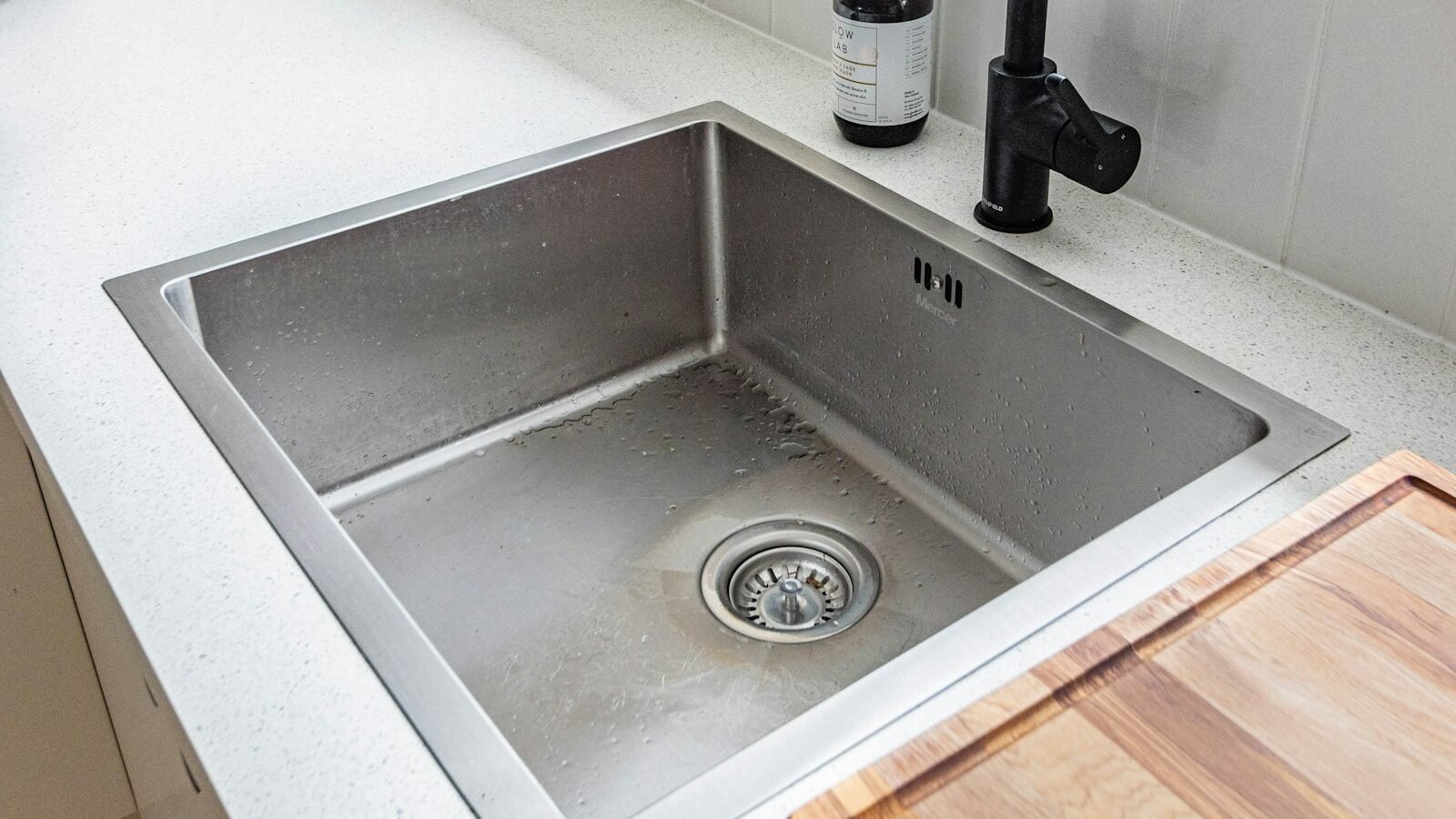
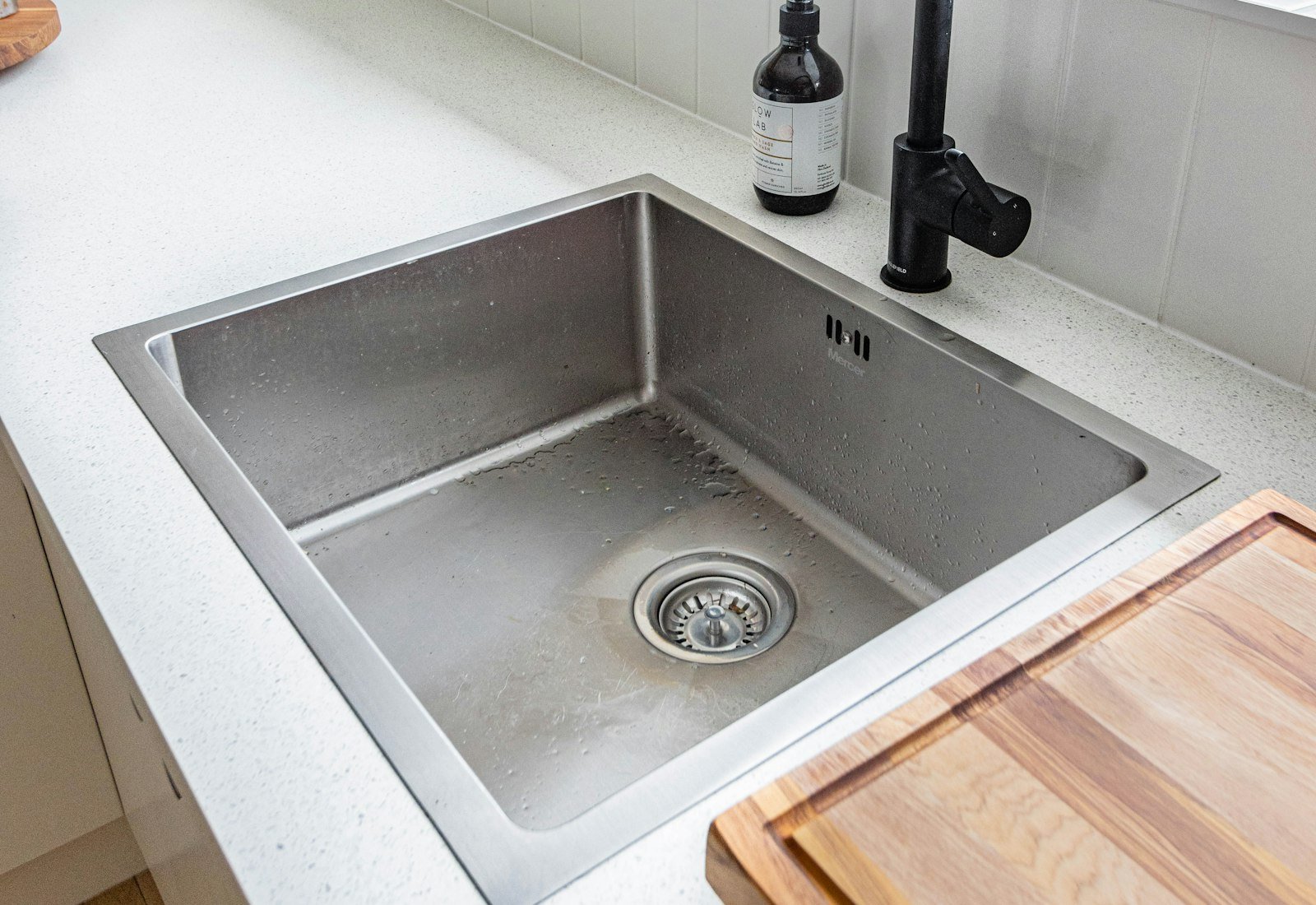
The kitchen sink is the second-most-used fixture in a UK home after the tap, and the one most people under-spec. A 600 mm stainless steel bowl is fine for a one-bed flat; the same bowl in a 5-bed family kitchen is a daily frustration. This guide is built around the decisions that decide whether the sink you choose in 2026 is still the right one in 2036: material, bowl configuration, mounting style, size, and the brand that actually backs its warranty in the UK.
Table of contents
- Why the sink is the second-most important fitting
- The five materials, in plain English
- Bowl configurations: single, 1.5, double, drainer
- Mounting: inset, undermount, Belfast, flushmount
- Sizing, depth and the cabinet it sits on
- UK brands worth shortlisting in 2026
- Installation: who fits what, and the cost
- Taps, wastes and the parts you forget
- Care that keeps the sink looking new
- Real 2026 UK prices
- Kitchen sink FAQs
- Final thoughts
Why the sink is the second-most important fitting
In a UK kitchen, the sink is touched more often than any other fitting except the tap. It also dictates three other things: the worktop cut-out, the base unit width, and the waste plumbing. Choosing the wrong size or wrong configuration means a new worktop, a new cabinet, or a re-routed waste. Choose it well and it will outlast two kitchens.
Three honest tests for “right sink”:
- Can you fit a large roasting tray flat in the bowl?
- Can two people use the kitchen at the same time without one of them standing over the other?
- Is the worktop either side of the bowl big enough to land a hot pan and a chopping board without overlapping?
If any of those is no, the sink is too small. The next size up almost always improves the kitchen for the next 15 years.
The five materials, in plain English
UK kitchen sinks in 2026 are made from one of five materials. Each has a real trade-off.
1. Stainless steel
Still the UK workhorse. About 60% of UK kitchen sinks are stainless steel. Three things determine quality: the grade of steel (304 is the right answer for a UK kitchen; 202 is acceptable for a budget install), the gauge (lower is thicker; 1.2 mm is the standard, 1.0 mm is budget, 1.5 mm is premium), and the finish (satin, brushed, or polished — satin is most forgiving of marks and water spots).
Honest lifespan: 20+ years for a good 1.2 mm 304 steel sink. Real pros: heatproof, stainproof, hygienic, recyclable, the cheapest option. Real cons: noisy (a waste kit and under-basin insulation helps), can scratch, and the thinnest grades dent if a pan is dropped.
2. Composite granite (or quartz composite)
About 80% granite or quartz particles bound with an acrylic or resin matrix. Harder than stainless, more heat-resistant (typically to 280 °C), quieter. The look is “stone”, in a colour range that has expanded to about 30 in 2026, from white through grey to black.
Honest lifespan: 15–25 years. The two UK leaders are Blanco (Silgranit) and Franke (Fragranite). Both have ranges over £300 for a 1.5 bowl. Real pros: silent, scratch-resistant, looks like stone. Real cons: heavier than steel, can mark with very hot pans (use a trivet), can chip if a heavy cast-iron pot is dropped on the edge.
3. Ceramic / fireclay
The classic UK farmhouse / Belfast sink. Made from fireclay (a vitreous china fired at 1,200 °C) or from a more modern ceramic. Heavy (a single 600 mm Belfast is 30–50 kg), beautiful, and will outlast the house.
Honest lifespan: 30+ years, often 50+. Real pros: timeless look, the most heatproof of all the materials, doesn’t mark from tea or coffee. Real cons: weight (the base unit must be reinforced, often with a custom-built cabinet), can chip on impact, the only sensible mounting is Belfast-style or sit-on.
Two top UK ceramic makers in 2026: Villeroy & Boch (the original “Belfast” look), and Shaws of Darwen (the heritage maker in Lancashire since 1842). Both have £400–£1,200 sinks with 10–25 year warranties.
4. Solid surface (Corian, Hi-Macs)
Seamless integrated sinks built into the worktop. The sink is the same material as the worktop, so there is no silicone seal to fail. The look is sleek, modern, very expensive. Corian and Hi-Macs are the two main UK brands.
Honest lifespan: 20+ years; scratches buff out. Real pros: seamless, hygienic, no silicone. Real cons: expensive (the worktop and sink are usually one quote, £3,000+), can mark with very hot pans.
5. Cast iron (enamelled)
The original kitchen sink. Heavy, traditional, and rare in the UK in 2026. Still made by Villeroy & Boch and a few small UK makers. £800–£2,000 for a single bowl. Worth it for a period kitchen.
Bowl configurations: single, 1.5, double, drainer
The second most important decision. Each configuration has a real use case.
- Single bowl, no drainer. The minimalist choice. Best for a small kitchen (under 4 m run) or a Belfast-style ceramic. Wipe the worktop into the bowl; no drainer to clutter the look.
- Single bowl with drainer. The standard UK 1.0 bowl. 500–600 mm wide, 400–500 mm bowl, drainer on one side. Fits a 600 mm base unit. Best for a one- or two-person household.
- 1.5 bowl with drainer. The most popular UK configuration. A full bowl + a half bowl, with a drainer. 950–1,000 mm wide. Fits a 600 mm base unit. Best for a 3–4 person household: the full bowl for washing up, the half bowl for rinsing veg or defrosting.
- Double bowl (equal) with drainer. Two full bowls side-by-side. 1,200 mm wide, fits a 800 mm base unit. Best for serious home cooks. Allows one bowl to soak while the other is used.
- Double bowl (no drainer, undermount). Two bowls under a stone or solid-surface worktop. Modern, very clean. Drain dishes on the worktop to one side. Best for a 4+ m kitchen where worktop is plentiful.
The honest 2026 UK pick: 1.5 bowl with drainer in stainless or composite. It fits a 600 mm base unit (the most common UK kitchen), handles 95% of UK homes, and a good one costs £200–£500 fitted.
Mounting: inset, undermount, Belfast, flushmount
Four ways the sink meets the worktop.
- Inset (top-mount). The sink drops into a cut-out in the worktop, with a 5–15 mm lip sitting on top. The standard UK fit, works with any worktop, the easiest to replace. Almost every UK kitchen sink is inset.
- Undermount. The sink sits under the worktop, with no lip visible. The worktop edge is exposed. Modern, clean, harder to clean around the joint. Requires a solid-surface, quartz, or granite worktop; not compatible with laminate.
- Belfast (sit-on). The ceramic Belfast sink sits on a base unit with the front of the sink exposed. No worktop cut-out around the bowl; the worktop runs into the sink. The classic UK country look. Requires a reinforced base unit.
- Flushmount. The sink and worktop are level, with a small reveal. Modern, expensive, very precise install. Used in high-end designer kitchens with stone or solid-surface worktops.
For 80% of UK kitchens, an inset stainless or composite sink in a 600 mm base unit is the right answer. The other three options are upgrades that depend on the worktop and the rest of the kitchen.
Sizing, depth and the cabinet it sits on
The three measurements that determine whether the sink fits.
- Cabinet width. The sink must fit on a base unit at least as wide as the sink’s outer dimension. A 600 mm sink fits a 600 mm unit (with about 36 mm of room). An 800 mm sink needs an 800 mm unit. A 1,000 mm sink needs a 1,000 mm unit (or a 600 mm unit with a side panel).
- Bowl depth. 150–180 mm is shallow, 180–200 mm is standard, 200–220 mm is deep, 220+ mm is a chef’s sink. Deeper bowls hide more dirty dishes but require more bending to reach the bottom. For a UK family kitchen, 190–200 mm is the sweet spot.
- Worktop cut-out. Most inset sinks come with a template. Check the template before the worktop is templated; the worktop is cut to match the sink, not the other way around.
A 600 mm base unit with a 1.5 bowl inset sink is the single most common UK kitchen spec in 2026. If you’re refitting an existing kitchen, the sink size is often the constraint that decides the rest.
UK brands worth shortlisting in 2026
UK kitchen sink market, by tier.
- Premium. Blanco (German, the UK composite-granite leader), Franke (Swiss, the UK stainless leader), Villeroy & Boch (the Belfast and ceramic heritage brand).
- Mid-range. Rangemaster (UK brand, wide range of stainless and composite sinks), Caple (UK brand, good mid-range ceramic and composite), Abode (UK brand, the sink-and-tap matching specialist), Astracast (UK, the Howdens and Benchmarx house-brand maker).
- Trade / builders. Astracast (above), Carron Phoenix (UK, the B&Q and Wren house-brand maker), Reginox (Dutch, the Howdens house-brand).
- Belfast / heritage. Shaws of Darwen (since 1842, the UK heritage fireclay sink), Villeroy & Boch, Belfast Sink Company (small UK maker).
Worth knowing: Wren Kitchens, Howdens, Magnet, B&Q and Wickes all sell sinks under their own brand, made by one of the trade brands above. The quality is the same; the warranty is usually shorter (1–2 years versus 15–25 years on the trade brand).
Installation: who fits what, and the cost
UK sink install in 2026 is typically done by the kitchen fitter, not a plumber. The cost depends on what else is being done.
- Sink-only swap (same size, same position, same waste): £120–£220 fitted, including disconnection, new tap holes if needed, re-sealing, and reconnection. Takes 2–3 hours.
- Sink + tap + waste kit (same position): £220–£350 fitted. Most common UK install.
- Sink + new worktop (sink cut into a new worktop): included in the worktop quote, typically £200–£400 of the worktop fitting cost.
- Sink + base unit change (moving from a 600 mm to an 800 mm unit, or adding a cabinet): kitchen fitter day rate of £200–£280 plus the unit cost.
- Belfast sink install: a reinforced base unit adds £120–£200 to the standard cabinet cost. Most kitchen fitters will not fit a Belfast without a custom unit built.
Two things to confirm in writing before the install: who supplies the waste kit (and whether it includes a trap, a waste pipe, and a dishwasher connection), and whether the old sink is being taken away.
Taps, wastes and the parts you forget
A £350 sink with a £40 tap looks like a £200 kitchen. A £200 sink with a £250 tap looks like a £1,200 kitchen. Tap matters.
- Mixer tap (single lever, hot and cold). The UK default. £40 for a basic chrome unit, £150–£300 for a quality ceramic-disc unit (the right answer), £400+ for a boiling-water tap (Quooker, Insinkerator, Grohe Red).
- Pull-out spray. Useful for rinsing the bowl and washing veg. The right answer for a 1.5 or double bowl.
- Boiling water tap. £600–£1,200 fitted for a Quooker or similar. Saves time and water. Worth it for a tea-drinking household, overkill for a one-person flat.
- Waste kit. The pop-up waste, the basket strainer, the overflow, the trap, the pipe to the drain. Budget £30–£80 for a complete kit. Buy it from the same brand as the sink to ensure a perfect fit.
- Insinkerator / waste disposal. Rare in the UK but useful in a busy family kitchen. £200–£400 fitted. Check that the local water authority allows them (most do).
The honest 2026 UK pick: a mid-range ceramic-disc mixer tap (Abode, Bristan, Grohe, Hansgrohe, Franke — all £120–£250) matched to a £200–£400 sink. The combined £350–£600 will look and feel like a £1,000+ kitchen.
Care that keeps the sink looking new
Three simple rules for any UK kitchen sink.
- Wipe it dry. The single biggest cause of “old-looking” stainless or composite is limescale from water that evaporated on the surface. A 5-second wipe with a tea towel after the last use of the day keeps the finish looking new for 10+ years.
- Don’t leave a wet cast-iron pan in a composite sink overnight. The iron can leave rust marks that are very hard to remove from composite. A Belfast ceramic is immune; a stainless is fine; a composite needs care.
- Use the right cleaner. For stainless: a drop of baby oil on a soft cloth, buffed in. For composite: a dedicated composite cleaner (Blanco, Franke, or HG). For ceramic: any cream cleaner. Never use a wire wool on stainless — it embeds iron particles that rust and stain.
Real 2026 UK prices
Sink, tap and waste, supplied and fitted, including VAT, 2026.
- Stainless steel 1.5 bowl, mid-range brand, with mid-range mixer tap: £350–£550 fitted.
- Composite granite 1.5 bowl, Blanco or Franke, with mid-range mixer tap: £550–£850 fitted.
- Ceramic Belfast, Villeroy & Boch or Shaws, with bridge mixer tap: £900–£1,600 fitted (including reinforced base unit).
- Stainless steel double bowl, premium brand, with pull-out spray tap: £500–£800 fitted.
- Undermount stainless or composite in a stone worktop, with boiling-water tap: £1,400–£2,400 fitted.
- Solid-surface integrated sink and worktop (Corian, Hi-Macs), single piece: £3,000–£5,500 fitted.
Frequently Asked Questions
Q1. What is the most popular kitchen sink configuration in the UK?
1.5 bowl in stainless steel or composite granite, inset-mounted, on a 600 mm base unit. About 55% of UK kitchen sink sales in 2026.
Q2. Is composite granite better than stainless steel?
Neither is “better” — they are different. Stainless is cheaper, lighter, fully recyclable, but noisier and scratches more visibly. Composite is silent, scratch-resistant, looks like stone, but is heavier and can mark with very hot pans.
Q3. How long does a UK kitchen sink last?
Stainless: 20+ years. Composite: 15–25 years. Ceramic Belfast: 30+ years, often 50. The first thing to fail is usually the tap, not the sink.
Q4. Can I put a Belfast sink in a 600 mm base unit?
No, not safely. A 600 mm Belfast weighs 35–55 kg and needs a reinforced cabinet. Most kitchen fitters will build a custom base unit for a Belfast, which adds £120–£200 to the cabinet cost.
Q5. Do I need a plumber or a kitchen fitter to install a sink?
A kitchen fitter. The waste connection is a standard push-fit; the water connections are isolation valves. A plumber is only needed if the pipework is being altered.
Final thoughts
The kitchen sink is the second-most important fitting in a UK kitchen, and the one that you do not want to under-spec. Go 1.5 bowl, 190–200 mm deep, on a 600 mm base unit, in stainless or composite. Spend £200–£400 on the sink, £150–£250 on a quality ceramic-disc tap, £30–£80 on a good waste kit, and the result will still look and work brilliantly in 2040. That is the right sink.
For More Information Visit Oak & Nook.



3 thoughts on “Best Kitchen Sink UK 2026: Materials, Bowls, Mounting and Brands”