Decorative Books: How to Choose, Style and Display Them in a UK Home
Decorative books can make a room feel collected rather than staged, but the best displays are not simply piles of books chosen for their covers. A good stack has the right scale for its surface, enough weight to sit securely, and a colour or subject connection with the room around it.
This guide treats decorative books as both styling objects and real books: choose genuine or faux volumes, measure the space, balance an arrangement and buy in the UK with confidence.
At a glance: choose real books when you value texture, provenance and the option to read them; choose faux books when you need consistent colours, sizes or a lightweight display. For most homes, a mixture looks more convincing than either extreme.
Contents
- What counts as a decorative book?
- Real books or faux books: which is right?
- Measure the space before you buy
- A practical colour and style formula
- 23 ways to style decorative books
- Where to buy decorative books in the UK
- Illustrative UK budget guide
- Decorative books FAQ
- Final thoughts
What counts as a decorative book?
A decorative book is a book selected partly for how it looks when displayed. It might be a well-used hardback with a beautiful cloth cover, a vintage Penguin or Pelican, a leather-bound volume, an art or travel book, or a purpose-made faux book with an empty interior.
The distinction matters because the choice changes the feel of the room. Real books bring uneven edges, faded spines, paper texture and history. Faux books bring control: matching heights, repeatable colours and a clean finish for an event, shop, holiday let or photo shoot.
Do not hide a book’s subject. Cookery, gardening, architecture or travel titles make a room feel personal when they reflect the people who live there. Readable collections also age more naturally.
Real books or faux books: which is right?
Choose real books for character and flexibility
Real books are the stronger choice when you want a display to feel authentic. Used bookshops, charity shops, book fairs and specialist sellers can produce better variation than a coordinated boxed set. AbeBooks’ decorating-with-books guide is a useful starting point for understanding formats and collecting ideas, while its marketplace can lead you towards vintage, illustrated and period-specific books.
Look for:
- cloth or textured covers rather than a row of identical glossy jackets;
- a mix of upright and landscape formats;
- readable titles that reflect an interest, place or period;
- sound bindings if the books will be handled regularly; and
- colours that repeat something already in the room, such as a rug, artwork or ceramic.
Remove dust jackets only when the hardback beneath is attractive and in good condition. If a jacket is fragile or valuable, keep it with the book rather than treating it as disposable decoration.
Choose faux books for consistency and low weight
Faux books work well where the display needs a very specific palette or a neat run of matching spines. They are also useful in a shallow cabinet, on a narrow ledge or in a display that will be moved often. The disadvantages are that the finish can look overly uniform and the object may have little or no usable interior.
Before buying, check whether a faux book is a solid block, hollow prop or hinged box. Do not use an insecure hollow cover for anything valuable.
A mixed arrangement is convincing: two or three real books, one coordinated faux volume and a small object to break up the rectangles.
Measure the space before you buy
Decorative books are easy to underestimate. A stack that looks modest online can dominate a small table, while a slim book can disappear on a deep shelf. Measure usable dimensions in centimetres.
For shelves and bookcases
- Shelf depth: allow at least 20–25cm for ordinary hardbacks; 28–35cm is more comfortable for large art, photography and coffee-table books.
- Shelf height: measure between the shelf surface and the underside above it. Keep at least 2–3cm of clearance above the tallest book so it can be removed without scraping the shelf.
- Bookcase width: avoid filling every centimetre. Leave roughly 10–15% of a bay visibly open, or use an object such as a vase to create a deliberate pause.
- Weight: check that a floating shelf, picture ledge or wall-mounted cabinet is rated for the combined load. A broad stack of hardbacks can be surprisingly heavy.
For coffee tables, consoles and bedside tables
A useful starting point is a two-to-four-book stack. The bottom book should be the largest and heaviest, with smaller books above it. On a coffee table, keep the stack low enough to preserve sight lines across the room; around 8–18cm high is usually easier to live with than a tall tower.
Leave a clear landing area for a mug, glass or lamp switch. On a small bedside table, one or two books beside the lamp may be enough. On a console, a vertical group of books can help anchor a lamp, but keep the front-to-back depth within the console’s usable surface so the arrangement does not project into a walkway.
For ledges and narrow picture shelves
Check the ledge’s front lip before choosing a book. A 10–15cm-deep ledge may only suit slim paperbacks or a single small hardback displayed face-on. Do not balance heavy books on a narrow ledge simply because the cover looks attractive; use a proper book support or choose a lighter prop.
A practical colour and style formula
Start with the room, not with a colour trend. Pick one dominant neutral, one supporting colour and one accent. For example, warm white, tobacco brown and olive green will look more cohesive than six unrelated bright spines.
A simple formula for a shelf or table is:
- 60% quiet tones: cream, charcoal, tan, faded blue, black or natural cloth.
- 30% supporting colour: a shade repeated in upholstery, artwork or flooring.
- 10% accent: one saturated, metallic or unexpectedly bright cover.
In a maximalist room, several strong colours can work if the books share a visual thread, such as age, typography or subject.
For a period home, vintage spines, marbled paper and leather tones can echo timber and brass. For a contemporary flat, large-format books with restrained lettering can create a graphic block. In a calm bedroom, avoid a high-contrast row directly beside the bed if you want the display to feel restful.
23 ways to style decorative books
These ideas are deliberately practical. For each, consider the surface, the book count and what will happen when the room is used normally.
1. Build a two-to-four-book coffee-table stack
Place the largest book at the bottom, turn the next one slightly, and finish with a small bowl or low object. Keep the top item stable and leave one side of the table clear. For more living-room formulas, see the existing Oak & Nook coffee table accents guide.
2. Use one oversized book as a plinth
A large art or architecture book can lift a sculpture or vase by 3–6cm. Check that the cover is flat and the object is not heavy enough to bow it.
3. Arrange a quiet colour block
Group four to eight books with related neutral spines, then interrupt the run with one contrasting title.
4. Turn selected books face-out
Display one or two covers face-out when the jacket or typography is particularly good. Keep the rest spine-out so the shelf remains useful. Face-out books are best on a shelf that is at eye level rather than high above a door.
5. Create a horizontal shelf stack
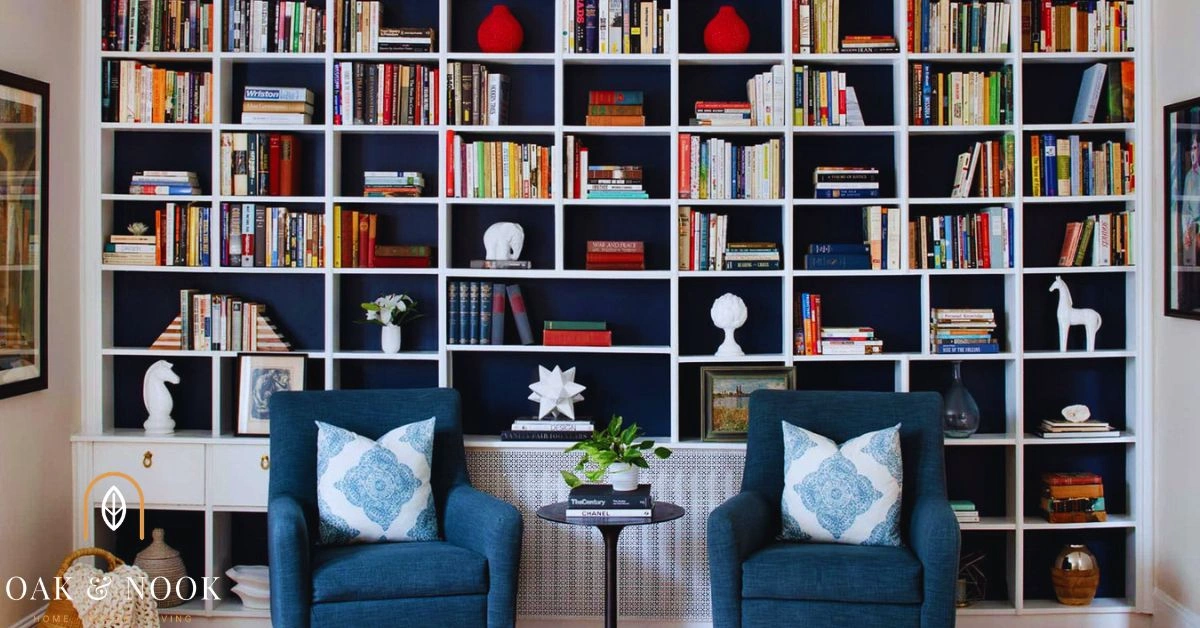
Lay three to five books flat in a bookcase bay, but do not stack them so high that the top one cannot be removed. A landscape stack looks intentional when the edges align on one side and the adjacent vertical books act as a visual stop.
6. Mix vertical and horizontal groups
Use a vertical run on one side of a shelf and a two- or three-book horizontal stack on the other. The change in direction adds rhythm without requiring lots of accessories.
7. Style a reading corner
Place a small stack on a stool, side table or low cabinet beside a chair. Add only one practical object, such as a reading light or coaster, so the arrangement remains usable rather than becoming a prop.
8. Anchor a console lamp
Put two or three books beneath a lamp base if the lamp is stable and the books sit fully on the console. Never use books to compensate for an unstable lamp; adjust the furniture or choose a smaller base instead.
9. Use books to soften a media unit
Break up a run of electronics with a short vertical group and a low landscape stack. Keep ventilation openings, cable routes and remote controls accessible. If you are planning the wider storage arrangement, link to the relevant Oak & Nook living-room accessories and styling guide.
10. Add height to a bedside arrangement
A single small stack can raise a clock or catchall to a more comfortable height, but keep the books away from a radiator, open flame or anything that may spill. Two slim books often look better than one very tall volume.
11. Colour-match a book to artwork
Choose a spine or cover that repeats a minor colour in a painting or print. Matching a small accent is usually subtler than buying a whole shelf of books in the same shade.
12. Collect by place
A group about a favourite city, region or landscape gives a display an authentic reason to exist. Mix sizes, but keep the collection to one shelf or one table so it reads as an edit rather than a theme park.
13. Collect by material
Cloth-bound books, aged leather, textured paper and muted dust jackets can all form a material-led arrangement. Inspect older books for damage before bringing them into a bedroom or cupboard; store them dry and away from persistent condensation.
14. Use a short stack as a doorway stop
In a wide bookcase or open shelving, a compact horizontal stack can stop the eye at the end of a run. Avoid using books as a physical doorstop or anywhere they could be knocked into a passage.
15. Create a low centrepiece
On a rectangular dining or console table, use a three-book stack with a shallow tray or bowl above it. Keep the overall height below roughly 25cm if people need to see across the table.
16. Style an open shelf in a kitchen
Cookery books can sit on an open shelf, but avoid the area immediately above a hob, kettle or sink where steam, grease and splashes will shorten their life. A wipeable faux book may be more practical for a purely decorative kitchen display.
17. Use a book as a colour bridge
When a room contains two timber tones, select a book with a warm neutral cover to connect them. This is a low-cost way to make mixed furniture feel deliberate without repainting or replacing it.
18. Make a small book wall
A shallow picture ledge or two properly fixed shelves can display covers face-out. Keep ledges level and avoid placing them above a bed or seating area unless fixings and load rating are suitable.
19. Turn a book into a discreet box
A hinged faux book or book-shaped box can conceal spare keys, matches or a remote. Keep valuables elsewhere and label it mentally or internally; the point is tidy storage, not security.
20. Style a seasonal rotation
Change one or two covers for a summer travel book, an autumn gardening title or a winter interiors volume. Rotating a small accent is less wasteful than buying a complete new display each season.
21. Use a matched pair
Two similar books can flank a vase, lamp or artwork on a long console. Leave enough space between the pair for the central object to breathe; symmetry works best when the surrounding furniture is already visually busy.
22. Combine books with one natural texture
Add one stone, wooden, woven or ceramic object to a stack. One contrasting texture is generally enough; several small ornaments can make the books look lost.
23. Let a lived-in shelf stay imperfect
The most convincing book displays contain evidence of use: a slightly different height, a folded page marker or a title that does not match the palette perfectly. Keep the books accessible so styling does not stop them being read.
Where to buy decorative books in the UK
Choose a source according to whether you want authenticity, consistency or convenience.
- Used and vintage books: start with local charity shops, independent bookshops, fairs and AbeBooks UK. Search by subject, binding or period rather than only by colour.
- Curated selections: Curated Books offers a specialist route for colour-coordinated, bespoke and trade/bulk selections, including books sold by the metre. This can suit a library wall, home staging or a project with a fixed palette.
- Faux and prop-style options: compare the construction, stated dimensions and weight on marketplaces such as Amazon UK, Etsy UK and the H&M Home UK books range. Treat marketplace photographs as inspiration, not proof of scale.
Before ordering, check whether the listing gives the dimensions of one book or the complete set, whether the books open, and whether the colour is printed, painted or naturally varied. If buying used books, ask about odour, damp, missing pages and binding condition when those details are not shown.
Illustrative UK budget guide
Prices vary by condition, size, binding and whether a selection is made for you. This is an indicative planning guide for October 2026, not a live quotation; confirm current prices and postage with the supplier.
- Low-cost styling: roughly £10–£35 for a small used-book group, charity-shop find or simple faux set.
- Edited everyday display: roughly £35–£100 for several good-condition hardbacks, a coordinated vintage selection or a larger faux arrangement.
- Premium or specialist display: £100–£250+ for leather-bound, rare, oversized, bespoke or trade-selected books. A full wall or metre-priced service may cost more once selection, delivery and installation are included.
Spend first on the size and condition you need: three well-scaled books usually look more considered than ten crammed onto an unsuitable shelf.
Decorative books FAQ
Are real books better than faux decorative books?
Neither is automatically better. Real books offer texture, history and reading value; faux books offer consistent colours, dimensions and often lower weight. Use real books where the display is handled or read, and faux books where a coordinated prop is the priority.
How many books should I stack on a coffee table?
Start with two to four. Use the largest book at the bottom, keep the stack around 8–18cm high, and leave a clear area for drinks or everyday use. Add a single low accessory rather than several small objects.
What depth should a shelf be for decorative books?
Allow at least 20–25cm for ordinary hardbacks and around 28–35cm for large art or photography books. Measure the usable shelf depth and check the book’s actual dimensions before ordering.
How do I make decorative books look authentic?
Mix formats and heights, include a few genuinely readable titles, avoid perfectly identical stacks, and repeat colours already present in the room. A small amount of irregularity is more convincing than an over-coordinated row.
Can decorative books be used in a kitchen or bathroom?
They can, but keep real books away from steam, splashes, grease and persistent damp. In a kitchen, choose a dry shelf away from the hob and sink. In a bathroom, a book-shaped waterproof prop is safer than valuable paper books, but it should still be kept away from direct water.
Final thoughts
Decorative books work when they solve a visual problem without creating a practical one. Measure the shelf or table, decide whether you need real character or faux consistency, and build a small arrangement around the room’s existing colours and materials. Two to four well-chosen books, with a little breathing space, will usually have more impact than a crowded collection.
For a UK home, the most useful buying rule is simple: choose books you would be happy to handle, store or read, then let the display grow gradually. That approach keeps the styling personal, makes the budget easier to control, and leaves room for the next book you actually want to own.
1 thought on “Decorative Books: How to Choose, Style and Display Them in a UK Home”