Grey Bedroom Ideas for UK Homes: Choose the Right Shade, Layout and Texture
Grey can be restful, dramatic, warm or cool. The difference is not the colour name on the tin; it is the undertone, daylight and what you put beside it. A blue-grey beside bright white can feel crisp, while the same depth with oak, linen and warm lighting can feel calm.

This guide is designed for real UK bedrooms rather than a gallery of disconnected looks. Start with the room’s light and dimensions, choose a grey family that will behave well there, then build around the bed, storage and textiles you already have.
Contents
- Choose the grey by light, not by name
- A quick grey bedroom decision guide
- Grey paint shades worth sampling
- Five measured room schemes
- How to make grey feel warm and layered
- Grey bedroom ideas that earn their space
- Lighting, finishes and practical details
- What a grey bedroom refresh may cost in the UK
- Frequently asked questions
- Final thoughts
Choose the grey by light, not by name
Before looking at colour cards, note which way the main window faces and when the room is used. North-facing light is often cooler and more even; a warm grey or greige can stop the room feeling steely. South-facing light is stronger and warmer, so a cool stone or blue-grey may look more balanced. East-facing rooms change quickly from bright morning light to a flatter afternoon, while west-facing rooms can look subdued earlier and golden later.
These are starting points, not rules. Trees, neighbouring buildings, glazing and the colour of the floor can matter as much as compass direction. Put a large sample on two walls, including one beside the window and one in the darkest corner. Look at it when you wake up, in the afternoon and with the lamps on. Dulux makes the same practical point in its UK grey-bedroom guidance: a shade can change noticeably between morning and electric light, so testing at more than one time matters (Dulux).
For a small bedroom, a pale grey can help the walls recede, but it will not magically add floor area. Keep the ceiling and most woodwork close in value to the walls if you want fewer visual breaks. If you prefer contrast, use it on one feature such as the skirting, headboard or curtain fabric rather than every edge.
A quick grey bedroom decision guide
Use this sequence before buying paint or new furniture:
- Need the room to feel brighter? Begin with a light grey or soft greige, a pale ceiling and fabrics with a little contrast. Avoid a blue-grey that looks lilac in your particular light.
- Want a cocooning room? Consider a mid or deep grey on all four walls, but balance it with a lighter ceiling, a generous bedside light and tactile bedding.
- Have a north-facing room? Sample warm greys with beige, taupe or stone notes. Bring in oak, walnut, rust, ochre or aged brass to add warmth.
- Have a narrow room? Place the darker tone on the short wall behind the bed and keep the long walls lighter, or paint the whole room one medium tone to make the corners less fussy.
- Already own patterned bedding or artwork? Choose a quiet, balanced grey and let those pieces supply the colour. A complicated undertone can fight with an existing pattern.
- Unsure about a feature wall? Paint a 1m-wide test panel behind the bed and live with it for a week. Use one when it clarifies the bed position; it is not compulsory.
Grey paint shades worth sampling
Paint brands describe their colours differently, so compare the actual samples rather than assuming that “light grey” means the same thing everywhere. The following families are more useful than a long list of fashionable names.
Soft, balanced greys
A pale neutral grey is the safest choice when you want a quiet backdrop for upholstered furniture, artwork or patterned curtains. It can work across a whole room, particularly when the ceiling is a slightly lighter version of the same family. Farrow & Ball’s current grey-bedroom gallery includes light options such as Ammonite, Dimpse and Cornforth White, alongside darker shades; use the gallery as a shortlist, not a substitute for samples (Farrow & Ball).
Warm greige
Greige sits between grey and beige. It is often more forgiving in a north-facing bedroom or a room with cream carpet and honey-toned wood. Pair it with chalky white, oatmeal linen, tobacco leather, muted pink or terracotta. If your existing furniture is very cool white, test carefully: a warm greige can make the furniture look blue by comparison.
Blue- and lilac-based grey
These greys feel clean with white linen, navy, soft pink or chrome. In a bright room they can work well, but test for a violet cast after sunset and balance them with warm bulbs or timber.
Slate and charcoal
A deeper grey gives a bedroom architectural weight. Use it behind the bed, inside alcoves or across all four walls where the room has adequate artificial light and you actively want a den-like mood. Charcoal does not need a large room; it needs a deliberate lighting plan and enough pale or reflective surfaces to keep the room usable.
Paint finish matters too: a low-sheen matt is usually calmer on broad walls because it reduces glare and disguises minor unevenness. Follow the manufacturer’s preparation instructions and choose a more durable finish for frequently handled woodwork.
Five measured room schemes
These are planning guides, not regulations; verify your bed, doors, skirting and wardrobe dimensions before ordering.
1. The compact double: approximately 2.7m × 3m
Keep the bed’s long sides at least 550–600mm from a wall where possible so you can change bedding and reach a bedside surface. If that leaves no space, use one proper bedside table and a narrow shelf on the other side rather than forcing two bulky cabinets into the room.
Paint all walls a light or mid warm grey and carry the colour behind the headboard. Add a 300–500mm-deep floating shelf, wall lights or slim plug-in sconces to free the floor. A 1,200–1,400mm-wide wardrobe can sit on the wall opposite the bed if its doors do not collide with the entrance; sliding doors are worth considering where the clear opening is tight.
2. The narrow double: approximately 2.4m × 3.6m
Put the bed on the short wall if a minimum 600mm route remains beside at least one side. If the bed must run lengthways, make the end of the bed a storage zone rather than a deep chest of drawers. A bed end clearance of around 600–750mm is a useful everyday target, but measure your door swing and walking route first.
A darker grey on the headboard wall can make the bed feel anchored. Keep the longer walls and ceiling lighter, and choose curtains that sit close to the wall colour so the window does not become another horizontal stripe.
3. The small single or box room: approximately 2m × 2.4m
Use a 900mm-wide single bed and keep one side visually open. A shallow desk around 450–500mm deep can double as a dressing surface, while wall-mounted shelves keep circulation clear. Consider a pale neutral grey on the walls with a darker grey inside one alcove or on the back of a bookcase.
Do not specify a deep upholstered headboard if it steals the difference between a comfortable passage and a sideways shuffle. A painted rectangle behind the bed can provide the same focal effect with no loss of floor area.
4. A bedroom with wardrobes on one wall
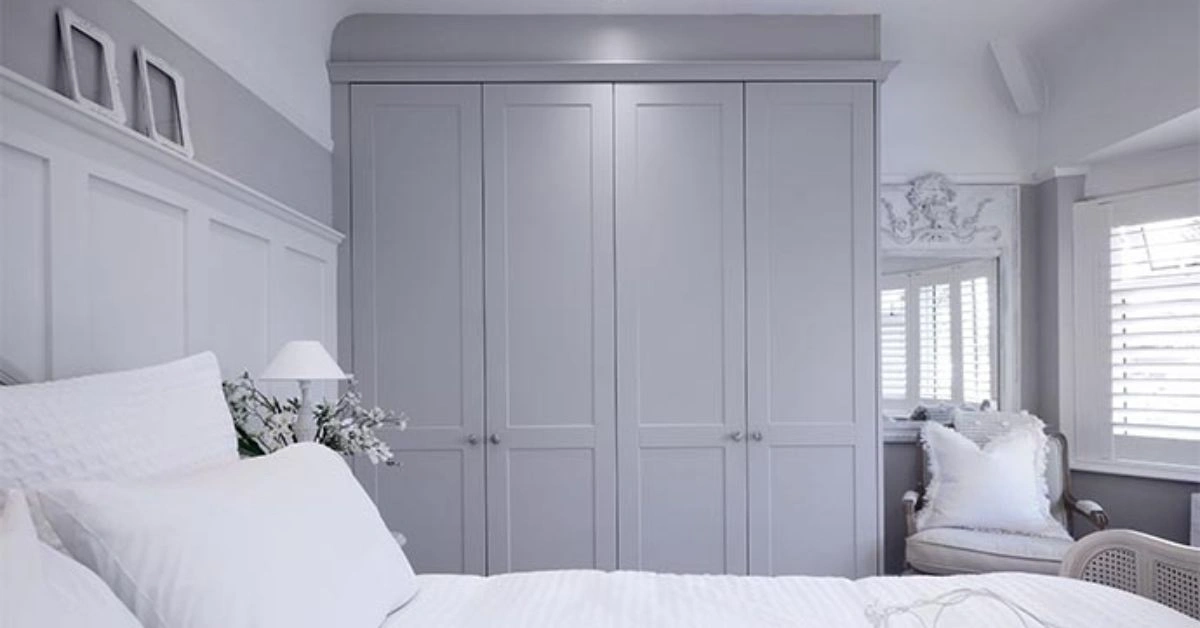
Measure from the wardrobe fronts to the opposite wall, not simply from skirting to skirting. Allow roughly 900mm in front of hinged doors as a practical planning target, then verify the manufacturer’s dimensions. If the route is narrower, sliding doors may work better. One grey across the wardrobes and surrounding walls can make storage feel built in.
How to make grey feel warm and layered
Grey becomes flat when every surface has the same smooth, cool finish. The cure is not necessarily more colour. Start with three tactile layers: washed cotton or linen bedding, a wool or quilted throw, and a rug with visible pile or weave. Then add one natural material such as oak, rattan, cane, seagrass or stone.
Choose one warm accent family and repeat it twice or three times. Rust can appear in a cushion and a small artwork; muted pink can connect the lampshade and a throw; brass can link drawer pulls and a picture frame. Repetition makes the room feel intentional without turning it into a matching set.
For a restrained scheme, keep the wall grey, bedding one shade lighter and the curtains one shade deeper. For a more collected room, use a blue-grey wall with olive, dusty rose or ochre in small doses. Dulux’s guidance also suggests pairing warm greys with cream, mustard or yellow, and lighter greys with teal, blue, purple or pink; use those combinations as prompts and test them against your actual paint sample (Dulux).
Grey bedroom ideas that earn their space
Paint the ceiling as part of the scheme
A ceiling that is stark white against a deep grey wall can look abrupt. In a darker room, use a softened white or a very pale version of the wall colour. In a small room, continuing a light grey over the ceiling can blur the boundary and make the space feel calmer.
Make a headboard wall do more than one job
A painted faux headboard can be a low-cost focal point. Mark a rectangle or arch behind the bed, keeping the lower edge behind the mattress and allowing enough width to include bedside tables. Use removable masking tape, a sharp cutting edge and two thin coats rather than one heavy coat. If you want physical depth, simple wall panelling can provide it; see Oak & Nook’s wall panelling ideas for a separate treatment of profiles and layouts.
Use the bed linen to control the temperature
Cool grey walls with white bedding can be fresh but austere. Add oatmeal, mushroom, faded denim or soft pink in the duvet cover and cushions. With a warm greige wall, crisp white linen can provide the contrast that stops the room becoming muddy.
Keep the bed visually calm: two or three cushion sizes are usually enough, and a folded throw at the foot introduces colour without covering the whole scheme.
Add one reflective note
A mirror, glass lamp base or aged-metal picture frame catches low winter light and prevents a charcoal scheme looking heavy. Avoid placing a mirror where it reflects an untidy storage zone or a harsh bare bulb; reflection only helps when what it bounces back is useful.
Keep wall art from disappearing
Against pale grey, black line drawings and warm wood frames give definition. Against charcoal, use lighter mats or pale frames. Hang the centre of a main picture around eye level, but lower a gallery above the bed so the lowest frame relates to the headboard.
For more broad paint-planning ideas, Oak & Nook’s room painting ideas for living rooms can be used for technique and sequencing; keep the bedroom scheme quieter and more sleep-focused.
Lighting, finishes and practical details
Plan three layers of light: general light for cleaning, bedside light for reading and a softer accent for the evening. A single central pendant rarely does all three jobs. Position bedside lights so the switch is reachable from the pillow, and check that a shade does not project into a wardrobe door or walking route.
Warm white bulbs generally make a grey bedroom feel more relaxed than very cool white light, but check the bulb packaging and use the same colour temperature across visible fittings. If the room contains makeup or a dressing mirror, add a separate, even light rather than relying on a dim bedside lamp.
Curtains should be measured from the track or pole to the required hem, not guessed from the window glass. If blackout matters, specify a suitable lining and allow for the stack of the curtains at either side of the window. In a small room, blinds can preserve wall space while a full-length curtain in a similar grey softens the window.
Before painting, fill and sand cracks, clean dusty walls and identify any damp or condensation problem. Paint will not solve moisture. If the room has persistent mould or damp, deal with the cause and get appropriate professional advice before decorating.
What a grey bedroom refresh may cost in the UK
These are indicative 2026 planning bands, not quotes. They assume a typical UK bedroom and vary with room condition, brand, access, region and whether you reuse existing furniture.
- Paint-only refresh: about £100–£350 for preparation materials, primer where needed and wall/woodwork paint. This is a planning allowance, not a live product basket.
- Textile-led update: about £250–£900 for new bedding, curtains or blinds, a throw, cushions and a rug, depending on sizes and natural-fibre choices.
- DIY feature wall or simple faux headboard: about £40–£180 for tape, tools and paint if the wall is sound.
- DIY panelling or a built-in-looking storage treatment: about £250–£800 for materials, trim, filler and paint; complex joinery costs more.
- Professional decorating: allow roughly £450–£1,200 for a straightforward bedroom, with repairs, wallpaper removal, high ceilings and regional labour potentially taking it higher.
Ask for labour and materials to be separated in a quote. Confirm how many coats, what preparation is included, whether furniture is moved, and whether the price includes VAT. A sample pot is cheaper than repainting four walls, so make it the first line in the budget rather than an afterthought.
Frequently asked questions
Is grey still a good choice for a bedroom?
Yes, provided you choose the undertone for the room and add enough warmth. Grey works particularly well when the furniture or flooring already contains timber, stone, black metal or soft neutrals. If your room is dim and full of cool white surfaces, choose a warm grey and plan layered lighting rather than relying on paint alone.
Which grey is best for a north-facing bedroom?
Start with warm grey or greige samples with beige, taupe or stone notes. Compare them beside your carpet, flooring and curtains. A shade that looks creamy in a south-facing showroom can look flatter at home, so judge the sample in the room across a full day.
Should all four walls in a bedroom be grey?
Not necessarily. Painting all four walls creates a quieter, more enveloping backdrop and can make awkward corners less noticeable. A feature wall is useful when you want to emphasise the bed or a fireplace. Use the room’s proportions and the furniture layout to decide, rather than treating a feature wall as a rule.
What colours go with a grey bedroom?
Warm white, cream, natural wood, muted pink, rust, ochre, olive, blue and brass can all work. The right choice depends on whether the grey is warm, blue-based or charcoal. Repeat your accent colour in at least two places, then leave some quiet surfaces so the room can breathe.
How do I stop a grey bedroom feeling cold?
Choose a warm undertone, layer linen or wool, introduce timber or woven materials and use warm, consistent lighting. Curtains, a rug and an upholstered headboard soften more effectively than adding several small decorative objects. If the room is already furnished, change the bedding and lighting before repainting.
Is dark grey suitable for a small bedroom?
It can be. Dark grey creates a deliberate, cocooning feel, but it needs a clear route, good bedside lighting and a few lighter surfaces. If the room is also short of daylight and storage, test a mid-grey first and reserve charcoal for the bed wall, alcoves or joinery.
Final thoughts
The strongest grey bedroom ideas begin with the room you have, not a shade that looked right in a photograph. Read the light, measure the routes around the bed and wardrobes, and sample warm, cool and balanced greys beside your real floor and fabrics. Then use texture, timber and layered lighting to give the neutral backdrop some life.
A pale greige can make a compact north-facing room feel settled; a blue-grey can sharpen a bright modern room; a charcoal can turn a large bedroom into a restful retreat. The successful choice is the one that still feels comfortable when the daylight changes, the door is closed and the room is being used every day.