
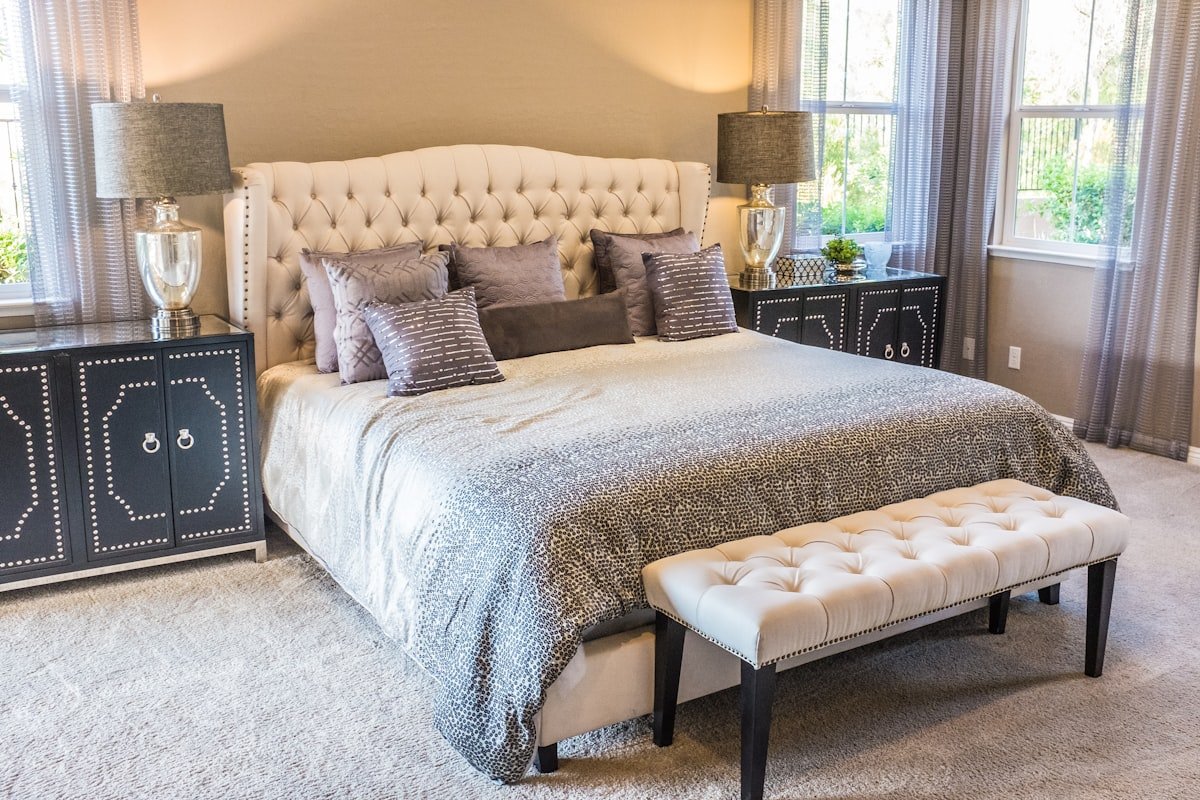
A small bedroom is not a small life. It is a 7m² to 10m² room that has to sleep, store, and be calm enough to fall asleep in, which is the hardest brief in interior design. This guide is a practical, room-tested list of UK interior design tips for making a small bedroom look bigger, without the usual magazine advice that ignores the wardrobe, the chest of drawers, and the reality of British light. The honest answer is layout, light, and restraint. Here is how to apply them.
Table of contents
- The principle: edit before you decorate
- Layout: the single biggest lever
- The bed: pick the right size and place it well
- Storage that earns its place
- Light, window, and the borrowed light trick
- Colour and finish in a small bedroom
- Furniture scale, legs, and glass
- Mirrors, the honest one-trick
- Floors and rugs
- Common small bedroom mistakes
- Small bedroom FAQs
- Final thoughts on small UK bedrooms
The principle: edit before you decorate
Every trick in this guide assumes one thing: the room is not over-filled. A small bedroom with too much furniture will look small no matter what colour it is. So before you paint, before you buy a bed, before you agonise over the curtains, edit. Get rid of the second wardrobe you do not need. Store the boxes under the bed. Move the chair that does not earn its place. The room will be 10 to 20 per cent bigger before you do anything else.
This is the principle: design the room for the life you actually live, not the life you think you should. A small bedroom for one person does not need a double wardrobe, two bedside tables, and a dressing table. A small bedroom for two people does not need all of those either, but it needs more thought about layout.
For inspiration on the wider restraint approach, see our Japandi interior design ideas and quiet luxury interior design guides.
Layout: the single biggest lever
Layout is the most powerful design tool in a small bedroom, and it costs nothing. Five rules that work in almost every UK small bedroom.
- Place the bed against the longest uninterrupted wall. Not the wall with the window, not the wall with the door, the wall with the most clear run. The bed will dominate the room; give it a calm backdrop.
- Leave 60cm to 70cm of walking space on at least one side of the bed. This is the minimum to make a bed, dress, and walk to a wardrobe. Less than 60cm and the room starts to feel broken.
- Put the wardrobe on the wall opposite the bed, not the side wall. A side-wall wardrobe chops the room in half and makes the bed feel squeezed. An opposite-wall wardrobe reads as one calm volume.
- Do not block the window. Bed under the window is fine if the window is high enough; tall wardrobe under the window is never fine.
- Keep the door swing clear. A 762mm door swing eats 1.2m² of room. A pocket door, sliding door, or outward-opening door is the single biggest layout change available.
The end-of-bed bench or chest is a useful addition only if the room is at least 3.2m long. In smaller rooms, a bench stops being a feature and starts being a daily obstacle.
The bed: pick the right size and place it well
The bed is the largest object in the room. Two decisions matter: size and height.
Size
- A 135cm (4ft 6in) double is the smallest bed for two people and the largest bed for a 2.4m wide room.
- A 150cm (5ft) double is the comfortable default for a couple, and fits in a 2.7m wide room.
- A 180cm (6ft) superking needs at least a 3.2m wide room to feel proportionate.
- A 90cm (3ft) single is the smallest bed worth buying for a regular sleeper. Anything smaller is a cabin bed and is fine for a child, not for an adult.
Height
Bed height is the unsung design choice. The right height is 45cm to 55cm from floor to mattress top, which is the height at which most adults can sit on the edge with their feet flat and stand up without strain. Higher than 60cm and the bed looks like a daybed in a hotel; lower than 40cm and it looks like a futon. A divan with a 25cm base plus a 20cm to 25cm mattress hits the sweet spot.
Headboard
A floor-to-ceiling upholstered headboard adds 30 to 50 per cent to the perceived size of the bed, makes the room feel more designed, and gives you a soft surface to lean against. In a small room, it is the single best upgrade. A slim line headboard, by contrast, makes the bed look like a mattress on a frame.
Storage that earns its place
Storage in a small UK bedroom is the difference between a calm room and a chaos room. The rules.
- Use the full height of the room. A 220cm-tall wardrobe stores 25 to 30 per cent more than a 195cm-tall wardrobe in the same footprint. If the ceiling is 2.4m, build a top-shelf above the wardrobe for out-of-season clothes and bedding.
- Use the depth. A 60cm-deep wardrobe is standard. A 45cm-deep wardrobe (sometimes called a slimline) is enough for shirts, trousers, and folded knitwear, and it frees 15cm of floor space. Brands like IKEA PAX and Wilko do 50cm-deep ranges.
- Under-bed storage is gold. A divan with four drawers underneath stores more than a chest of drawers. A 135cm double with four drawers holds roughly the same as a 90cm-wide chest of drawers, but uses zero extra floor space.
- Built-in beats free-standing in small rooms. Built-in wardrobes reach floor to ceiling, fit the exact width of the wall, and lose the dead space above a free-standing unit. The cost is £1,500 to £4,000 for a small room; the saving in floor space and visual calm is worth it.
- Choose sliding doors. A sliding wardrobe door saves 60cm to 80cm of door swing in front of the wardrobe. In a 2.4m wide room, that is the difference between a usable bedside and a wardrobe you cannot fully open.
For a deeper look at the storage side, see our multifunctional furniture for small UK homes guide and our modular furniture guide.
Light, window, and the borrowed light trick
Light is the second-most powerful tool in a small bedroom. Two layers: natural and artificial.
Natural light
- Keep the window as clear as possible. No heavy pelmets, no curtains that block the upper third of the window. A simple pole with curtains that fall to the sill, or a Roman blind inside the recess, lets in the maximum light.
- If you can, switch a solid internal door for a glazed or part-glazed door. Borrowed light from the landing or another room transforms a small bedroom.
- Mirror opposite the window, not adjacent. A mirror that reflects the window doubles the natural light in the room. A mirror that reflects a wall doubles the wall.
Artificial light
- Three layers. Ceiling light (3000K warm white), bedside reading lights (2700K, switched at the bed), and a soft accent (a wall light, a small table lamp on the chest). The bedside light is the most useful; the ceiling light is the least.
- Wall-mounted reading lights free the bedside table. A swing-arm wall light at the headboard height is 50cm to 80cm of clear bedside space, which is the difference between a usable surface and a decorative ledge.
- Dimmer switches on the main light. A 5-minute, £30 upgrade that turns a bedroom into a calmer space after dark.
For the wider light and ceiling play, see our statement ceiling ideas guide, which has good options for small rooms.
Colour and finish in a small bedroom
Colour does not make a small room bigger, but it can stop a small room feeling smaller. The rules.
- One wall colour, not three. A calm single colour across all four walls reads as one calm volume. A feature wall in a small bedroom usually looks like a band-aid on a problem.
- Mid-tone is the most forgiving. Pure white shows every mark and looks clinical. A soft warm white, putty, or pale grey-green hides the everyday and still feels calm.
- Match the woodwork to the walls, not the ceiling. A soft warm white woodwork in a coloured room makes the room feel taller; a bright white woodwork in a coloured room makes the room feel choppy.
- Matt finish hides the mess. Matt emulsion is the right finish for bedroom walls. Slight sheen is for kitchens and bathrooms.
For a deeper look at the colour side, see our colour scheme for your home UK guide.
Furniture scale, legs, and glass
The shape of the furniture matters as much as the colour of the walls. Three rules that make a small bedroom feel bigger.
- Visible legs make furniture feel lighter. A divan bed looks heavier than a bed on legs. A chest of drawers on a plinth looks heavier than one on short legs. Lightness in a small room reads as space.
- Glass and acrylic disappear. A glass bedside table, an acrylic chair, or a small acrylic stool gives you a surface without visual weight. Useful for one or two accent pieces, not the whole room.
- Scale the furniture to the room. A 90cm-wide chest of drawers in a 2.4m wide room is too big. An 80cm chest is right. The 10cm difference is the difference between a chest you walk around and a chest you walk into.
Mirrors, the honest one-trick
Mirrors are the most over-claimed and under-used tool in small bedroom design. A small mirror over the chest is decoration. A full-height mirror on a wall, or a large mirror opposite a window, doubles the perceived size of the room. The rule is size, not count. One big mirror is worth five small ones.
- Full-height mirror on the inside of the wardrobe door. Free, useful, and disappears when the wardrobe is open.
- Large mirror on the wall opposite the window. Doubles the light and the room.
- Mirror inside a frame, in a size that is proportional to the wall. A 60cm x 80cm mirror on a 3m wall looks lost. A 120cm x 80cm mirror fills the wall and the room.
Floors and rugs
Floors matter in a small bedroom. Two choices.
- Run the same flooring through the whole house. Continuous flooring makes every room feel larger, because the eye reads the floor as one surface, not a series of boxes. The exception is the bathroom and the kitchen, where the floor covering changes for practical reasons.
- One rug, not three. A 200cm x 140cm rug under the bed, with 50cm of floor on each side, frames the bed and warms the room. Multiple small rugs in a small room look like a series of islands.
Common small bedroom mistakes
The mistakes that come up again and again, with the fix.
- Too much furniture. The single most common small-bedroom mistake. If the room has a bed, a wardrobe, and one other piece, that is usually enough.
- Heavy curtains that block the window. Blackout is useful; floor-to-ceiling heavy fabric is visual weight. Use a blackout lining inside a Roman blind or a curtain that stops at the sill.
- Feature wallpapering one wall. A small bedroom reads as one surface. Pattern on one wall splits the room. Either paper all four walls or paint all four.
- Bed under a window in a deep sill room. If the window sill is below 1m, the bed is awkward to climb into and the curtains are impossible. Move the bed to a solid wall.
- Buying a superking because it sounds nice. A 180cm bed in a 2.6m wide room is wrong. The bed should suit the room, not the desire.
- Lighting from the ceiling only. A single pendant in the middle of a small bedroom leaves the corners dark. Add a bedside light and a soft accent.
- Too many cushions on the bed. A small bed dressed with eight cushions is no longer a bed; it is a display. Two or three, max.
Frequently Asked Questions
1. What is the best bed size for a small UK bedroom?
For a 2.4m wide room, a 135cm (4ft 6in) double. For a 2.7m wide room, a 150cm (5ft) double. For a 3.0m wide room, a 180cm (6ft) superking. Anything larger in a smaller room will make the room feel broken. As a rule, leave at least 60cm of clear floor on at least one side of the bed and 30cm on the other.
2. How do I add storage to a small UK bedroom without built-in wardrobes?
Use the under-bed with a divan and four drawers. Use the full height of the room with a 220cm-tall free-standing wardrobe from IKEA PAX or a similar range. Add a slim 30cm-wide tallboy between the wardrobe and the wall, which fits in gaps that usually do nothing. Use a headboard with built-in shelving or a shallow niche above the bed for books and the alarm clock.
3. What colour makes a small bedroom look bigger?
A soft, mid-tone warm neutral reads as the largest in a small bedroom. Pure white shows marks and looks clinical; very dark colours shrink the perceived size. The best choices for UK bedrooms are soft warm whites, putty, pale grey-green, or a muted blue-grey. Farrow & Ball Ammonite, Little Greene French Grey, and Dulux Timeless are typical safe bets.
4. Should I put a mirror in a small bedroom?
Yes, but a large mirror on a wall opposite the window, not a small mirror over the chest. A full-height mirror on the inside of the wardrobe door is the most useful location because it doubles as a dressing mirror and disappears when the wardrobe is open. Avoid mirrored wardrobes in a small bedroom; they reflect clutter and look dated.
5. How do I make a small bedroom feel luxurious?
Three things: a floor-to-ceiling upholstered headboard, a single piece of large art or one large mirror, and bed linen that looks like a hotel. The room should have one focal point, not three. The quiet luxury interior design guide has more on this approach.
6. Is a fitted or free-standing wardrobe better for a small bedroom?
A fitted wardrobe is better in a small bedroom. It uses the full height of the room, fits the exact width of the wall, and removes the dead space above a free-standing unit. The cost is higher (£1,500 to £4,000 for a small room), but the storage per square metre is roughly 30 per cent better and the visual calm is worth it. Sliding doors save 60cm to 80cm of door swing in front of the wardrobe.
Final thoughts on small UK bedrooms
A small UK bedroom that works is a room that has been edited, laid out well, and finished in a single calm colour. Most of the work is the layout and the edit, not the decoration. Get the bed against the longest wall, store vertically, light in three layers, and let one piece of art or one large mirror be the focal point. The room will look bigger because the room is calmer, and the room is calmer because there is less in it.
For the wider context, see our guides to Japandi interior design ideas, multifunctional furniture for small UK homes, and oak furniture buying guide UK.

6 thoughts on “How to Make a Small Bedroom Look Bigger: UK Interior Design Tips”