
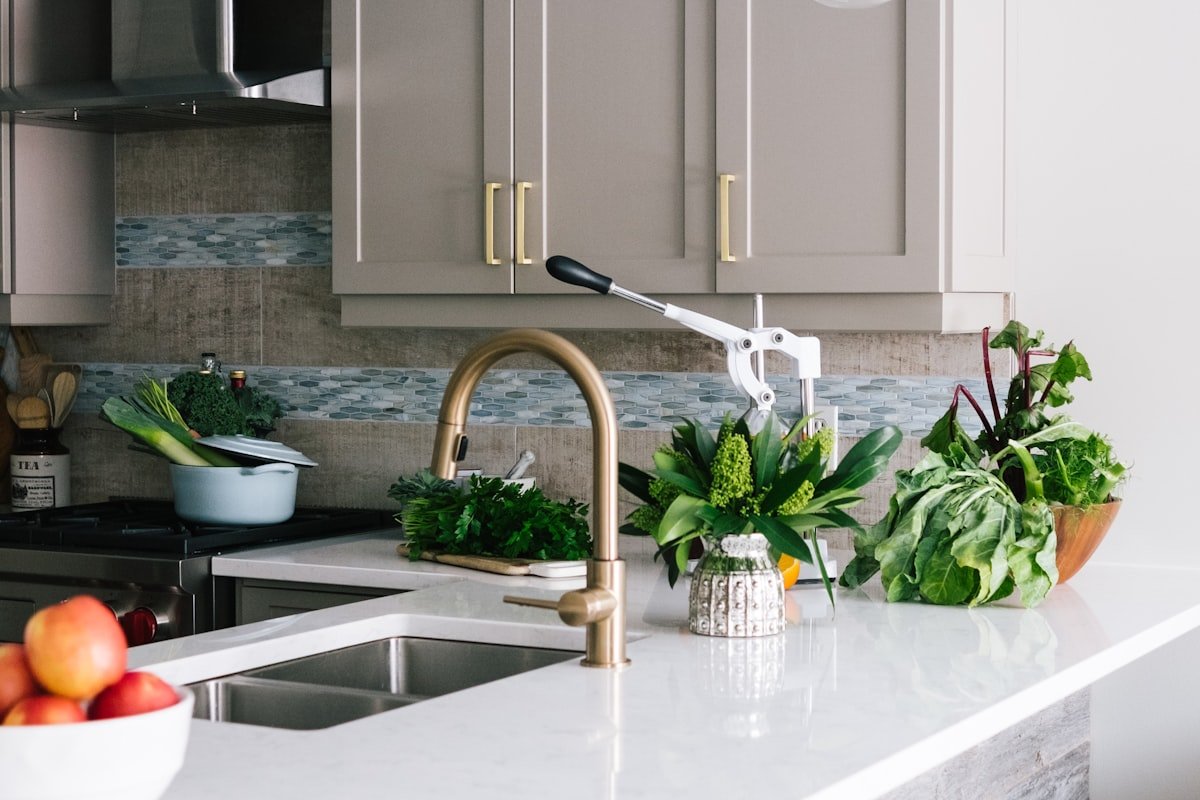
The best kitchen lighting in a UK home is rarely one ceiling rose and a strip light. Most UK kitchens are 8 to 14 square metres, are used for cooking, homework, entertaining and laundry, and have a single window that struggles in winter. A single central pendant leaves your face in shadow at the worktop, washes the splashback in glare, and makes the room feel smaller than it is. The right scheme layers three types of light, picks the right colour temperature, and pays attention to British building rules for switches, bathrooms and kitchen wiring. This guide is a practical, UK-specific walkthrough of the schemes, fittings and prices that actually work.
Table of contents
- Why kitchen lighting in UK homes is different
- The three layers: ambient, task, accent
- Colour temperature, CRI and the warm-white debate
- How bright is bright enough? Lux levels for kitchens
- IP ratings, bathroom zones and kitchen safety
- Dimmers, smart switches and Part P
- Best kitchen lighting products available in the UK
- How to lay out a kitchen lighting scheme
- UK cost guide and where to buy
- Common mistakes
- Kitchen lighting FAQs
- Final thoughts
Why kitchen lighting in UK homes is different
UK kitchens have three constraints that you do not always find in US or European buying guides. First, the ceiling is usually 2.3 to 2.4 metres, not 2.7, so pendants need to be hung carefully. Second, the consumer unit is almost always a BS 7671 split-load or dual-RCD board, and kitchen circuits are usually on the RCD side, which constrains what dimmers you can fit. Third, British winter means 16 hours of artificial light between November and February, so the colour temperature and CRI of the lamps genuinely affect how the room feels.
The upshot is that the “bright white 6000K LED strip” you see on Amazon is almost always the wrong answer. It flatters no one, kills the warmth of a wood worktop, and turns a 6pm cup of tea into an operating theatre. The best kitchen lighting is layered, warm, dimmable, and designed for the way the room is actually used.
The three layers: ambient, task, accent
Every good kitchen scheme has three layers. You do not have to buy all three, but the room will feel flat if you do not.
Ambient (general) light
This is the overall fill. In a UK kitchen it is usually a flush ceiling fitting, a low-profile LED panel, a row of recessed downlights, or a central pendant over a dining table. The job of ambient light is to remove dark corners and let you move around safely. Aim for a baseline of around 100 to 150 lux at floor level.
Task light
Task light is directed at the worktop, the hob, the sink and any open shelving. In practice it is delivered by under-cabinet LED strips, recessed downlights over the front edge of the worktop, or a linear pendant above an island. The Energy Saving Trust recommends around 300 to 500 lux on food preparation surfaces. Under-cabinet strips are the single highest-impact upgrade in most UK kitchens, because the human body always casts a shadow between a ceiling downlight and the worktop.
Accent light
Accent is the optional layer. It is the LED strip inside glass cabinets, the small spotlight that picks out a print, the picture light above a kitchen table. It is not essential, but it is what separates a kitchen that looks lit from one that feels designed. If you are combining kitchen and dining in a small open-plan layout, accent is also what stops the space from looking like a canteen at night. For more on layering light across open-plan spaces, see our japandi interior design guide.
Colour temperature, CRI and the warm-white debate
Colour temperature is measured in kelvin (K). For UK kitchens the sensible range is 2700K to 3000K for ambient and task, and 2700K to 2400K for accent. Anything above 3500K starts to feel clinical; anything below 2400K makes food look slightly off-colour. CRI (Colour Rendering Index) measures how accurately a lamp shows colours. Aim for CRI 90 or above, particularly over the food prep and dining zones. Most cheap GU10 LEDs are CRI 80, which is fine for a hallway but unforgiving in a kitchen.
If you are replacing halogen downlights (still common in 2000s-build UK kitchens), check the cap type. MR16 needs a 12V transformer; GU10 is mains. Modern LED GU10s from Philips, Aurora and Soraa are genuinely 50W halogen replacements for 5W.
How bright is bright enough? Lux levels for kitchens
Lux is the unit of light at a surface. The UK government’s building regulations Approved Document L sets minimum energy-efficiency targets but not specific lux levels. The practical guidance, from the Society of Light and Lighting (CIBSE Lighting Guide LG2 and LG7, both used as UK benchmarks), is:
- 100–150 lux at floor level for general movement.
- 300 lux on worktops for general food prep.
- 500 lux on detailed tasks like chopping vegetables or reading a recipe.
- 150–200 lux at the dining table during a meal – dimmable, not fixed.
A useful rule of thumb for a 10 square metre kitchen: roughly 1,500 to 2,000 lumens of ambient light, plus 1,500 to 2,500 lumens of task light over the worktop run. An LED strip under a 3 metre run of wall units typically delivers 600 to 900 lumens.
IP ratings, bathroom zones and kitchen safety
Kitchens are not the same as bathrooms, but the rules still matter. A standard IP20 fitting is fine for the ceiling and under cabinets. Around the sink, where splashes are common, you want at least IP44. Downlights directly above a sink or hob should be IP65. If the kitchen is open-plan to a dining area, the lighting circuit must still be RCD-protected, which it usually is in any UK consumer unit installed after 2016.
For more on UK wiring rules, the NICEIC and NAPIT both publish consumer guides, and any new circuit work in a kitchen must be signed off under Building Regulations Part P by a registered competent person.
Dimmers, smart switches and Part P
Dimmable LEDs need trailing-edge dimmers, not the leading-edge dimmers that were common in UK homes until the 2010s. A leading-edge dimmer on a modern LED usually causes flicker, buzzing or limited dimming range. Brands to look for: Varilight V-Pro, Hamilton, and Click Scolmore Minigrid. If you have a smart home setup, modules from Philips Hue, Lightwave or Lutron Caseta (via Amazon UK) replace the dimmer entirely.
Wiring work in a kitchen is notifiable under Part P. You can change like-for-like fittings and swap switches without telling building control, but you cannot add a new circuit, move the consumer unit, or run a new cable to a new switch position without involving a registered electrician. The cost of signing off a small kitchen rewire is around £120 to £180 in 2026.
Best kitchen lighting products available in the UK
There is no single “best” fitting – a kitchen is a combination of zones. The list below covers the categories you actually need.
1. John Lewis & Partners in-house ceiling pendants – from about £80
Best for: anyone fitting out a whole kitchen and wanting a single trusted retailer with a 2-year guarantee. The in-house range covers flush ceiling fittings, linear pendants above islands, and drum shades in linen and metal. Build quality is consistent, returns are easy, and the chain keeps spares for years. Price range: £80 to £450 for a kitchen-rated pendant.
Pros: huge range in store and online, consistent finish quality, easy returns. Cons: not the cheapest, the in-house brand is unbranded so you cannot buy spares elsewhere.
2. IKEA kitchen lighting – from £10
Best for: budget whole-kitchen refits. The TRÅDFRI and MITTLED ranges cover LED strips, integrated under-cabinet lights, and connectable spotlights. The newer OMLOPP under-cabinet range is a 2024 update with better diffusers and a slimmer profile. Price range: £10 to £150 per fitting, £25 for a 60cm under-cabinet strip.
Pros: the lowest prices for the build quality, easy to extend with the TRÅDFRI gateway if you want smart control. Cons: design is generic, the drivers are bulky, and the 5cm cut increments on strips can be limiting.
3. Philips Hue White and Colour Ambiance – from £70 per bulb
Best for: people who want app and voice control of every light. Hue is the most reliable smart lighting system in the UK: the bulbs are CRI 80 at white, CRI 80 at colour, and the new GU10 range uses Bluetooth so you can start without the bridge. Price range: £70 per GU10, £120 for a starter kit, £60 for the bridge.
Pros: rock-solid smart control, integrates with Alexa, Google and Apple Home, broad accessory range. Cons: closed ecosystem, expensive once you multiply bulbs across a whole house.
4. Aurora Enlite and AOne smart downlights – from £15
Best for: replacing existing GU10 halogens or fitting a fresh grid of downlights. Aurora is a UK trade brand stocked at Edmundson, CEF and other electrical wholesalers. The AOne smart downlight is Zigbee 3.0 and works with Hue, SmartThings and the AOne app. Price range: £15 for a fixed downlight, £45 for the smart version.
Pros: trade-grade build, 5-year warranty on most ranges, the smart module is genuinely affordable. Cons: dimmer compatibility still needs checking against specific LED drivers.
5. B&Q Colours and GoodHome under-cabinet LED – from £18
Best for: a quick, in-store purchase. B&Q stocks the GoodHome range in every store, with linkable strips, mains and battery options, and a 4-year guarantee on most models. The strip is 2700K and CRI 80, which is fine for a utility kitchen. Price range: £18 to £80.
Pros: in-store, can return easily, linkable, and the 4-year guarantee is unusual at the price. Cons: light quality is fine rather than inspiring, the connectors are a bit fiddly.
6. Tom Dixon, Heal’s and Original BTC designer pendants – from £250
Best for: the dining end of an open-plan kitchen, or anyone who treats the pendant as a piece of furniture. These brands are stocked at Heal’s, Selfridges, and John Lewis. Price range: £250 to £2,500 for a statement piece. Pair with a warm 2700K filament LED (CRI 90) for the right effect.
Pros: design-led, hold value, and the diffusers are designed to control glare properly. Cons: the price of a single pendant will buy a whole IKEA scheme.
How to lay out a kitchen lighting scheme
A useful starting point is to draw your kitchen in plan view and mark four zones: dining, perimeter, island and sink. Each zone wants a different light source.
- Dining table: a pendant 60 to 70cm above the surface, sized to roughly half the width of the table. If the table is 1.6m long, a 70 to 90cm linear pendant reads correctly.
- Perimeter worktop: under-cabinet LED strips as close to the front edge of the wall unit as possible. If you do not have wall units, recessed downlights 60cm off the wall, spaced 80 to 100cm apart.
- Island or peninsula: two or three mini pendants, or a single linear LED pendant 70cm above the surface.
- Sink: a recessed IP65 downlight directly above, or a small picture-light style fitting on the wall if you have a window.
For layouts that combine a kitchen and a small dining space, our smart kitchen storage ideas guide shows how lighting can be tied to a wider rethink of the room.
UK cost guide and where to buy
A full lighting refit for a typical 10 square metre UK kitchen, including two pendants, six downlights, a 4-metre under-cabinet strip, a dimmer and an electrician, costs around £1,200 to £2,500 in 2026. The electrician is usually £250 to £450 for a day. The fittings vary wildly: a complete IKEA scheme can come in at £250; a designer Tom Dixon pendant alone is £600.
Best UK retailers by category: John Lewis and Heals for designer fittings; B&Q, Screwfix and Wickes for trade downlights and bulk buys; The Lighting Company, Pooky and other independent stores for decorative pendants; Amazon UK for smart bulbs. Trade pricing is often 20 to 30% cheaper than retail at Edmundson, CEF, and Rexel.
Common mistakes
- One big central pendant and nothing else. You will cook in your own shadow and the worktop will be the darkest part of the room.
- Cool white 4000K everywhere. It flatters no food, no skin and no wood. Stay 2700K–3000K.
- CRI 80 strips behind glass cabinets. The contents will look flat. Spend the extra £20 on a CRI 90 strip.
- Putting a dimmer on a non-dimmable LED. It will flicker or refuse to dim. Check the packaging.
- Forgetting the RCD. Any new kitchen circuit must be RCD-protected. If your consumer unit is pre-2016, get it checked.
- Buying pendants that are too long. In a 2.3m ceiling, a 1.2m pendant will hang at head height over a dining table. Adjust the drop or buy a fitting with a cuttable cable.
Frequently Asked Questions
1. How many downlights do I need for a UK kitchen?
A rough rule for a 2.4m ceiling is one GU10 downlight per 1.5 to 2 square metres of floor area, set 60cm off the wall and spaced 80 to 100cm apart. For a 10 square metre kitchen that is 6 to 8 downlights, ideally on two-way switching with a dimmer.
2. Should kitchen lights be warm white or cool white?
Warm white (2700K–3000K) is the right choice for most UK kitchens, because it flatters wood, paint and food. Cool white (4000K) is acceptable in modern grey kitchens and clinical utility rooms, but reads as harsh in a family kitchen.
3. Are LED strip lights bright enough to be the only task light?
A high-output strip (1,000 to 1,500 lumens per metre) can replace under-cabinet downlights. Cheaper strips at 300 to 500 lumens per metre are fine as supplementary light but you will need another source for serious chopping and reading recipes.
4. Do I need an electrician to change kitchen lights?
Like-for-like swaps (pendant for pendant, downlight for downlight) are not notifiable under Part P. Adding a new switch position, running a new circuit, or installing a new fitting point is notifiable and must be done by a registered competent person.
5. What is the best smart lighting system for a UK kitchen?
Philips Hue is the most reliable, with the widest accessory range. Lightwave is the best option if you want to keep your existing wall switches (it makes smart dimmer plates that fit standard UK back boxes). IKEA TRÅDFRI is the cheapest credible option, particularly if you already have other IKEA smart devices.
6. How do I light a small kitchen-diner?
Use one pendant above the table, a row of downlights along the kitchen run, and a slim under-cabinet strip. Avoid three separate pendants in a small room – they crowd the ceiling and make the space feel low. See our multifunctional furniture guide for small UK homes for related ideas on compact layouts.
Final thoughts
The best kitchen lighting in a UK home is rarely the most expensive. A mid-priced John Lewis or IKEA pendant, a few well-placed Aurora downlights, a CRI 90 under-cabinet strip, and a trailing-edge dimmer will outperform a £2,000 designer fitting that is on the wrong colour temperature. Sort the layers first, the colour temperature second, and the smart controls third, and you will have a kitchen that works in November as well as it does in June. For more on energy-efficient choices across the home, see our energy-efficient home upgrades UK guide.

1 thought on “Best Kitchen Lighting for UK Homes: A Practical Buyer’s Guide”