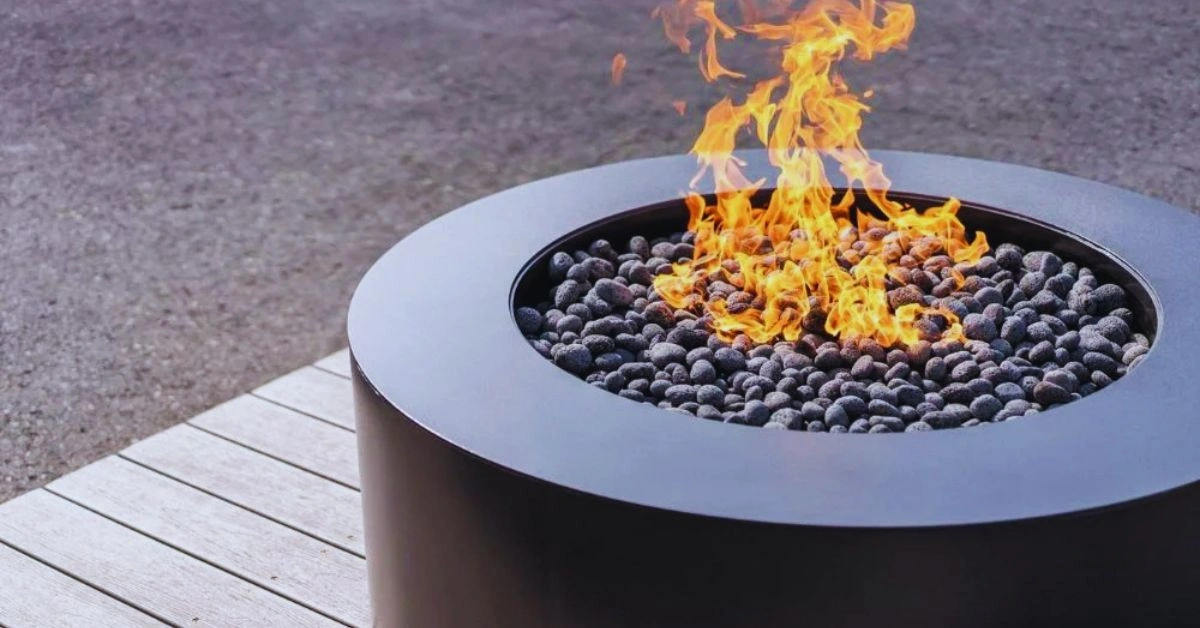
A firepit with gas gives you flame on demand without smoke, ash or a woodpile, which is why it has largely displaced wood-burning bowls in urban and suburban gardens. It is also a gas appliance, and that changes the buying checklist entirely. Certification, a flame failure device and where the cylinder lives matter more than how the bowl looks.
Nothing below replaces the manufacturer’s instructions for your specific model. Gas appliances vary, and the manual is the authority on ignition, clearances and cylinder connection.
Quick answer
A gas fire pit burns propane or butane from a cylinder or a fixed supply, lighting instantly and producing no smoke or ash. Buy only models carrying UKCA or CE marking and a flame failure device that cuts the gas if the flame goes out. Use outdoors in open air only, keep the cylinder upright and outside, and maintain the clearances stated in the manual to anything combustible.
Why choose a firepit with gas over wood
The practical case is smoke. Many UK towns and cities are designated Smoke Control Areas, where restrictions apply to emitting smoke, and a neighbour affected by persistent smoke can raise a statutory nuisance complaint with the council regardless of where you live. A gas fire pit sidesteps both issues because it produces no meaningful smoke. You can check whether your address falls inside a Smoke Control Area on your local council’s website.
The everyday differences are just as relevant. Gas lights in seconds, adjusts with a dial, and goes out when you turn it off, which matters if you have children or want to go indoors without waiting for embers to die. There is no ash pan to empty and no dry log store to find. Against that, you get less radiant heat per pound than a wood fire, no crackle, a cylinder to swap, and a higher purchase price.
If you are weighing up a full seating arrangement around the flame, our guides to fire pit tables and garden furniture with a fire pit cover the layout side in more detail.
Types of gas fire pit
| Type | How it works | Best suited to |
|---|---|---|
| Fire pit table | Burner set into a table top; cylinder hidden in the base | Patios where the surface doubles as a table for drinks |
| Fire bowl | Open bowl on a stand, cylinder alongside or beneath | A focal point in a seating circle |
| Fire column / tower | Tall narrow flame at standing height | Small courtyards and narrow terraces |
| Built-in burner kit | Burner and pan installed into masonry you build or commission | Permanent outdoor rooms; needs competent design and ventilation |
| Portable tabletop | Small burner running on a cartridge | Ambience only; very little heat output |
Fire pit tables are the most popular because they hide the cylinder and earn their footprint. Check whether the model includes a lid or cover plate so the burner area becomes usable table surface when it is off, and whether the cylinder compartment is genuinely ventilated. A sealed cabinet around a gas cylinder is not acceptable; enclosures must be vented as the manufacturer specifies.
What to check before buying
- UKCA or CE marking. Outdoor gas appliances sold in the UK should be assessed against the relevant standard in the BS EN 498 family. Products carrying neither mark should be avoided.
- Flame failure device. A thermocouple or similar cut-off that shuts the gas if the flame is extinguished by wind or a spill. This is the single most important safety feature; do not buy without it.
- Regulator and hose supplied. Confirm the correct regulator type for your cylinder is included, and note the hose’s replacement interval. Hoses perish and should be inspected each season.
- Fuel type. Propane works down to low temperatures and must be stored outdoors. Butane is less suitable in cold weather. Check which the appliance is set up for; regulators are not interchangeable.
- Burner output. Quoted in kW. A higher figure means more heat and faster gas use, so match it to how exposed your seating area is.
- Wind guard. A glass surround keeps the flame stable and stops it being blown across the table. Note that the glass gets hot.
- Media. Use only the lava rock, fire glass or ceramic media specified. The wrong material can trap moisture and shatter, or block burner ports.
- Cover. A fitted cover keeps water out of the burner and cylinder compartment over winter.
Handling the cylinder safely
This is the part of gas fire pit ownership that deserves genuine care. LPG cylinders should be kept upright, outdoors, in a well-ventilated position, away from drains, basements and heat sources. Propane in particular must not be stored indoors, in a garage, shed or under-stairs cupboard. The HSE publishes guidance on the safe use of LPG that is worth reading once before your first cylinder change.
When connecting or changing a cylinder, do it outside, with no ignition sources nearby, and check the connection with a leak-detection spray or soapy water rather than a flame. If you smell gas, turn off the cylinder valve, do not operate switches or ignition, move away and let the area ventilate. Turn the gas off at the cylinder valve first, then at the appliance control, whenever you finish using it.
Positioning and clearances
Follow the clearances in your manual, and treat the following as the minimum discipline on top of them:
- Outdoors and in open air only. Never in a conservatory, garage, tent, or under a closed canopy. Any gas appliance can produce carbon monoxide, and enclosed spaces are where that becomes dangerous.
- Well clear of fences, sheds, hedges, overhanging branches, parasols and awnings. Radiant heat and hot air rise further than people expect.
- On firm, level ground. A rocking slab or soft lawn under a loaded fire pit table is a hazard, particularly with a cylinder inside.
- Use a heatproof mat on decking, artificial grass, porcelain or resin. These surfaces mark or scorch readily.
- Keep a clear route past it. A fire pit in a doorway or the main path across a patio invites accidents.
- Under a pergola, check the manufacturer explicitly permits it and that there is generous open airflow on all sides. Many models do not allow it at all.
If you are building an outdoor cooking and seating area around it, our outdoor kitchen BBQ layout guide and BBQ shelter guide cover clearances and ventilation for covered structures, which is where most mistakes are made.
Using one well
Light it following the manual’s sequence, which usually means opening the cylinder valve, then igniting at the control while the burner is on a low setting. If it does not light within a few seconds, turn the control off and wait for gas to disperse before trying again, rather than repeatedly clicking the igniter.
Never leave it burning unattended, and never leave it lit when you go indoors or to bed. Keep children and pets at a distance and make it clear that the surround and any glass stay hot after shut-off. Do not move a fire pit while it is lit or still hot. Have a means of raising the alarm nearby, and keep the area free of tablecloths, cushions and dry planting that can catch.
Running cost depends on burner output and how long you sit out. A mid-size burner run for two or three hours on an evening will work through a cylinder over a season of regular use, so factor cylinder refills into the ongoing cost when comparing against wood.
Maintenance through the year
At the start of each season, inspect the hose for cracks, softness or perishing and replace it if there is any doubt or if it is past the manufacturer’s stated life. Check the regulator seal, clear debris and cobwebs from burner ports with a soft brush, and make sure drainage holes in the burner pan are clear so rain cannot pool around the ports.
Wash the surround with warm soapy water rather than a pressure washer, which forces water into gas components and lifts powder coating. Store the appliance covered over winter, ideally with the cylinder disconnected and kept upright outside. Replace fire glass or lava rock when it becomes discoloured or has broken down into dust, since fines can block the burner.
Frequently Asked Questions
1. Are gas fire pits safe?
Used as intended they are among the safest outdoor fire options, because there are no sparks or embers and the flame stops when you turn it off. Safety depends on buying a UKCA or CE marked model with a flame failure device, using it outdoors in open air, keeping the manufacturer’s clearances, and storing the cylinder upright outside.
2. Can I use a gas fire pit under a pergola or gazebo?
Only if the manufacturer specifically permits it and there is generous open airflow on every side. Many models prohibit any overhead cover. Never use one inside a conservatory, garage, tent or enclosed canopy, because of both fire risk and carbon monoxide build-up.
3. Do gas fire pits give off much heat?
Enough to make a patio comfortable into the evening, though generally less radiant warmth than a wood fire of similar size. Heat output is quoted in kW, and a wind guard makes a noticeable difference by stopping the flame being pushed sideways.
4. Where should I store the gas cylinder?
Outdoors, upright, in a ventilated spot away from drains, basements and heat. Propane must not be stored indoors or in a garage or shed. If the cylinder sits in the fire pit table’s base, that compartment must be vented as the manufacturer specifies, never sealed.
5. Can a gas fire pit be left outside all winter?
The appliance can, under a fitted cover, provided burner drainage is clear so water does not pool in the pan. Disconnect the cylinder and keep it upright outdoors. Check the hose and regulator before first use in spring rather than after.
Final thoughts
Choose a gas fire pit on its certification and its flame failure device first, then on size and looks. Get the cylinder arrangement and clearances right on day one, read the manual properly, and the appliance becomes the least troublesome heat source in the garden.
If you are still deciding between formats, our fire pit table guide compares gas and wood layouts, and garden lanterns covers the softer lighting that works alongside a flame feature.