Cast aluminium garden furniture sits at the durable end of the outdoor market, and the reason is simple: the metal is poured into a mould as solid sections rather than bent from hollow tube. That makes it heavier, more detailed and far less likely to blow across the lawn in a February gale. It also makes it more expensive, so it is worth knowing which parts of the specification earn the difference.
Cast and tubular aluminium get sold side by side under the same “aluminium” heading, and the photographs rarely make clear which you are looking at. The distinction changes weight, price, repairability and how the set behaves in wind.
Quick answer
Cast aluminium garden furniture is made by pouring molten aluminium into moulds, producing solid, heavy components with moulded detail. It will not rust, holds its position in wind, and can last decades. Judge a set on powder coat quality, whether joints are welded rather than bolted, total weight, and whether replacement feet, cushions and fixings are available.
Cast versus tubular aluminium
| Cast aluminium | Tubular / extruded aluminium | |
|---|---|---|
| How it is made | Molten metal poured into sand or die moulds | Hollow tube extruded, then cut and bent |
| Weight | Substantial; a dining chair often 7-10kg | Light; a chair may be 3-4kg |
| Wind behaviour | Stays put in most UK weather | Can be moved or tipped by strong gusts |
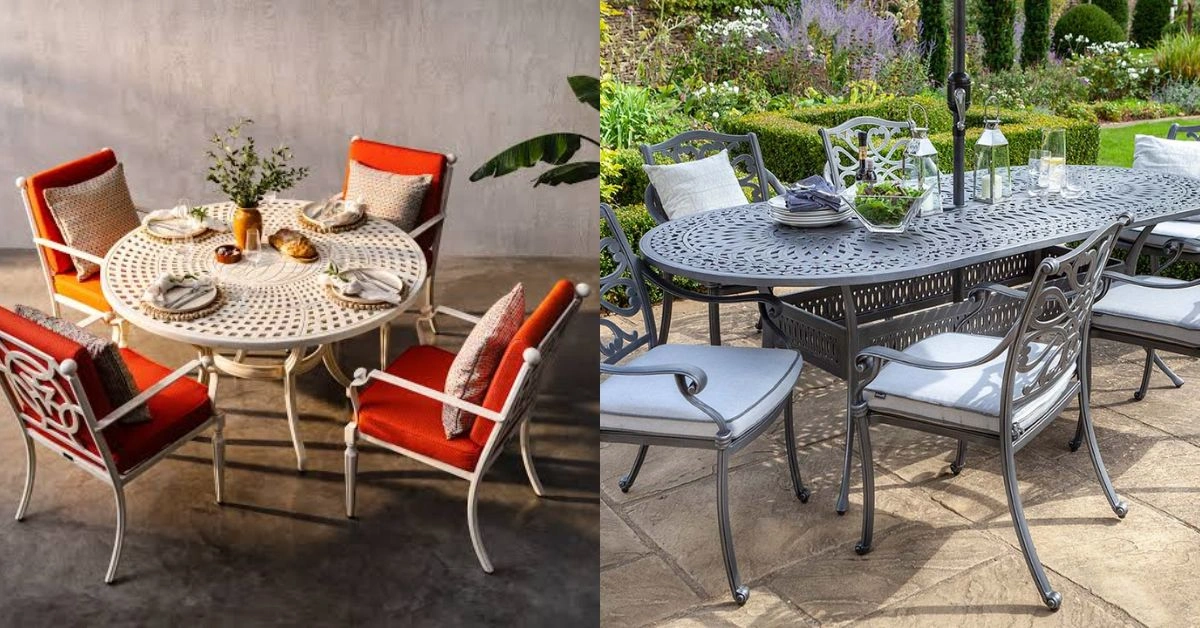
| Detail | Moulded patterns, scrollwork, textured surfaces | Clean lines only; no moulded detail |
| Style | Traditional and transitional | Contemporary and minimal |
| Storage | Heavy to move; rarely stacks | Light, often stackable |
| Cost | Higher | Lower for equivalent seat count |
Neither is simply better. Cast is the right answer for an exposed patio where furniture stays out all year and you want it to feel solid. Tubular is the right answer for a small balcony, a roof terrace with a weight limit, or anywhere the set needs carrying in and out. Where cast clearly wins is longevity through neglect: it is heavy enough not to move, thick enough to survive knocks, and has no hollow cavity for water to sit in.
Weight cuts both ways. A cast six-seater is a two-person job to reposition, and on a roof terrace or balcony you must check the structure’s loading before ordering. Our general aluminium garden furniture guide covers the lighter end of the range, and 6 seater garden furniture works through the footprint sizing.
Why it does not rust
Aluminium has no iron in it, so it cannot form the red-brown iron oxide we call rust. Exposed to air it develops a thin, tight oxide layer that slows further corrosion instead of flaking away as steel’s does. That is the fundamental reason a cast aluminium set survives British weather where a steel one eventually fails from the inside out.
It is not entirely immune. In coastal or heavily salted environments aluminium can suffer pitting or white powdery corrosion where the protective coating has been breached, and contact between aluminium and dissimilar metals in wet conditions can accelerate corrosion at fixings. Both are manageable: rinse salt off a few times a season, and touch up coating chips promptly rather than leaving bare metal exposed.
The powder coat is the part that fails first
Cast aluminium components effectively never wear out. What deteriorates is the finish, so this is where to concentrate your questions.
- Powder coated, not painted. Powder coating is applied electrostatically and oven-cured into a hard, thick film. Wet paint on outdoor aluminium chips and fades far sooner. If a listing says “painted” or vaguely “coated”, ask.
- Pre-treatment. Good manufacturers chromate or otherwise pre-treat the casting before coating so the powder bonds properly. This is invisible and rarely advertised, but it is the difference between a coating that stays put and one that lifts at the edges.
- Marine grade for coastal use. If you are near the sea, look for a marine-grade or architectural-grade specification.
- Touch-up paint. Ask whether a matching touch-up is available. Chips happen, and sealing them quickly stops any creep under the film.
- Colour. Darker finishes get noticeably hot in direct sun and show chalking from UV sooner than mid greys and stones.
A cast set can be stripped and re-powder-coated years later, which is genuinely worth knowing. It is a specialist job with a real cost, but it means a tired twenty-year-old set can be brought back rather than replaced. Very few outdoor furniture materials offer that.
Joints, fixings and feet
Look closely at how a chair is put together. Welded joints at the frame are stronger and stay tight; bolted joints on thin sections work loose over seasons and produce the wobble people blame on the whole material. On a cast frame the sections are thick enough to weld well, so welded construction is a reasonable expectation at this price.
Fixings should be stainless steel. Plated steel bolts in an aluminium frame will corrode and stain the coating around them. Check the feet too: cast furniture is heavy, so hard feet will scratch porcelain, mark resin-bound surfaces and dent decking. Rubber or felt glides are cheap protection and are often the first thing to need replacing.
Outdoor seating sold in the UK is generally assessed against the BS EN 581 series for outdoor furniture, which covers strength, durability and stability. It is a fair question to put to a retailer, particularly for benches and any chair with a reclining mechanism.
Tabletops and cushions
Cast aluminium tables come with several top options and they behave very differently. A cast aluminium top with a moulded pattern is virtually indestructible but drums under crockery and traps crumbs in the pattern. Tempered glass looks light and shows every mark. Ceramic and sintered stone are excellent, heat and stain resistant, and heavy enough that the table becomes a genuinely two-person lift. Slatted aluminium drains well and is the easiest to keep clean.
Cushions matter more on cast furniture than most people expect, because solid metal is unforgiving to sit on and gets cold early in the evening. Look for a quick-dry foam core with removable, washable covers. Solid foam in a fixed cover holds water for days and eventually smells. Our outdoor cushion storage guide covers ventilated boxes that make the drying routine realistic, and garden furniture covers explains why a breathable, vented cover beats a fully waterproof sheet.
Caring for cast aluminium garden furniture through the year
Cast aluminium is close to maintenance-free, but a short routine keeps the finish looking new for far longer.
- Wash with warm water and mild detergent using a soft brush or cloth at the start and end of the season. Rinse and dry.
- Never use a pressure washer. It drives water into joints and can lift powder coating at edges.
- Avoid abrasive pads, scouring cream and solvent cleaners; they dull and thin the coating.
- Rinse off salt and de-icing residue if you are near the coast or a treated road.
- Touch up chips as soon as you see them.
- Check and tighten any bolted connections once a season.
- Over winter, cover it or lift the feet clear of standing water. The metal is fine wet; feet sitting in a puddle for months are not.
- Bring cushions into ventilated storage, dry rather than merely out of the rain.
Is it worth the extra cost?
It is if the set is going to live outdoors permanently, if your garden is exposed, or if you want traditional detailing that tube cannot produce. The economics work over a long horizon: a cast set that gets washed twice a year and re-coated once in its life will outlast three cheap sets, and can be repaired rather than replaced.
It is not worth it if you need to carry furniture up to a balcony, if you have a weight limit to respect, if you want stackable chairs for a small shed, or if your taste is firmly modern and minimal. In those cases a well-specified tubular set with thick-wall tube and welded joints is the better buy, and the money is better spent on cushions and a good cover.
Frequently Asked Questions
1. Is cast aluminium garden furniture better than tubular aluminium?
It is more durable, heavier and more wind-stable, and it can carry moulded detail. Tubular aluminium is lighter, cheaper, often stackable and better suited to balconies or anywhere furniture must be moved regularly. Choose by how the set will be used, not by assuming one material wins outright.
2. Can cast aluminium garden furniture be left outside in winter?
Yes. It will not rust, so it can stay out year-round. Use a breathable, vented cover or lift the feet clear of standing water, keep the powder coating chip-free, and always bring cushions into dry, ventilated storage.
3. Does cast aluminium garden furniture blow over?
Far less than tubular aluminium or plastic, because the solid sections make each piece considerably heavier. In very exposed positions it is still sensible to close parasols, stow lightweight accessories and check that tables with large tops are not acting as sails.
4. How do you repair chipped powder coating?
Clean and dry the area, lightly key the edge of the chip, and apply a matching touch-up paint in thin coats. Do it promptly so the exposed aluminium does not start to oxidise under the surrounding film. Badly weathered sets can be stripped and professionally re-powder-coated.
5. How heavy is cast aluminium furniture?
Expect roughly 7-10kg for a dining chair and considerably more for a table, especially with a ceramic or stone top. Assume any repositioning is a two-person task, and check structural loading before putting a cast set on a balcony or roof terrace.
Final thoughts
With cast aluminium you are buying the finish and the engineering, not the metal, because the castings themselves will outlive most gardens. Ask about pre-treatment and powder coat grade, look for welded joints and stainless fixings, confirm parts availability, and then wash it twice a year and leave it alone.
If you are planning the wider patio around it, our outdoor dining set guide covers table sizing for real meals and cantilever parasols deals with the shade and base-weight side.