6 seater garden furniture is the size most UK households eventually want and the size most often bought badly. Six places sounds modest on a product page, then the set arrives and there is nowhere to stand behind the chairs. The number of seats is the easy part; the footprint, the frame and the winter routine are what decide whether you still like the set in year three.
Before comparing anything, chalk or tape the full footprint onto your patio, chairs pulled out, and walk around it carrying a tray. That single exercise prevents the most common and most expensive mistake in outdoor furniture.
Quick answer
A six-seater dining set needs roughly 3.5m x 3.5m of clear space if the table is round, or about 4.5m x 3m if it is rectangular, once chairs are pulled out and there is room to walk behind them. Powder-coated or cast aluminium frames handle British weather with least fuss, and any set left outdoors needs a breathable, vented cover rather than a plastic sheet.
Sizing 6 seater garden furniture to your patio
The table dimensions in a listing are not the space you need. Allow around 750mm behind each seated position for a chair to be pushed back and someone to walk past. Corner and bench arrangements need less, which is why they suit narrow patios.
| Set type | Clear space needed (chairs out) | Best for |
|---|---|---|
| Round 6-seat dining | approx. 3.5m x 3.5m | Square or awkward patios; sociable, no head of table |
| Rectangular 6-seat dining | approx. 4.5m x 3m | Long, narrow patios and decking runs |
| 6-seat corner / L-shape lounge | approx. 3m x 2.5m | Small gardens; seats sit against walls and fences |
| Cube set (chairs tuck under) | approx. 2.5m x 2.5m stored | Tight spaces where the set must shrink when unused |
| Bench and table (6 places) | approx. 3m x 2m | Family use; benches slide fully under the table |
Fitting furniture around planting and paths is worth planning at the same time, and the RHS guidance on garden design is a useful reference for keeping circulation routes usable. Measure the usable area, not the whole garden. A patio that is 4m wide but has a drain cover, a step and a door swing in it may have only 3m of genuinely clear ground. Doors that open outwards onto the patio are a frequent surprise, since they need their arc kept free.
Dining, lounging or a hybrid
Decide how the space will mostly be used before choosing a shape. A dining set at standard table height (roughly 74cm) is best for meals and for working outside, but it is upright and formal for an evening drink. A low lounge set is far more comfortable to sit in for two hours and hopeless for eating anything that needs a knife.
Rising or adjustable-height tables split the difference, moving between coffee-table and dining height. They cost more and add a mechanism that can seize if it is never lubricated or is left uncovered all winter. If you want one, check whether the mechanism is gas-strut or manual crank and whether replacement parts are sold separately.
A corner set is the strongest choice for a small garden because it uses the perimeter. The trade-off is flexibility: modular corner pieces can be rearranged, while a fixed-frame corner sofa cannot. Our guide to planning an outdoor L-shaped seating layout goes into the clearances in more detail, and the outdoor dining set guide covers table sizing for meals.
Frame materials that survive a UK winter
| Material | Strengths | Watch for |
|---|---|---|
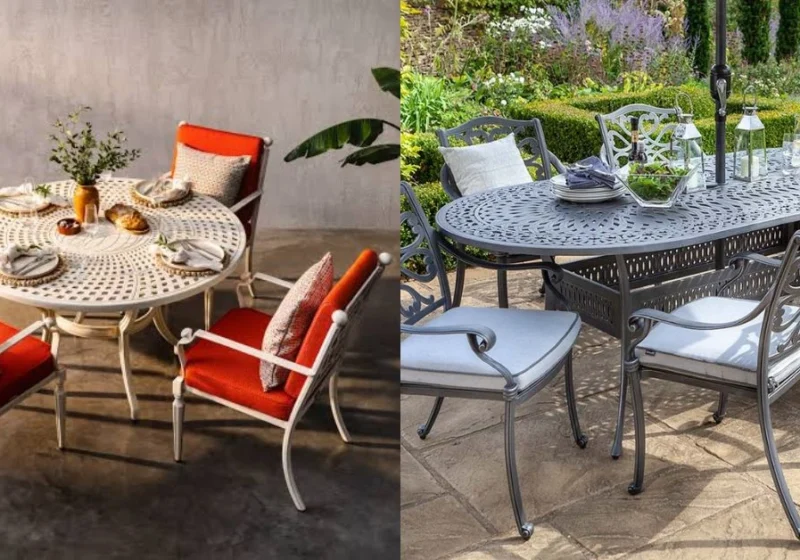
| Cast aluminium | Will not rust, heavy enough to stay put, detailed castings | Powder coat can chip; cost is higher |
| Tubular aluminium | Light, rust-free, easy to move and store | Blows around in gales; thin-wall tube flexes |
| Steel | Cheap, strong, very heavy | Rusts from the inside out once the coating is breached |
| Teak and hardwood | Ages beautifully, very stable, repairable | Needs annual cleaning; silvers unless oiled |
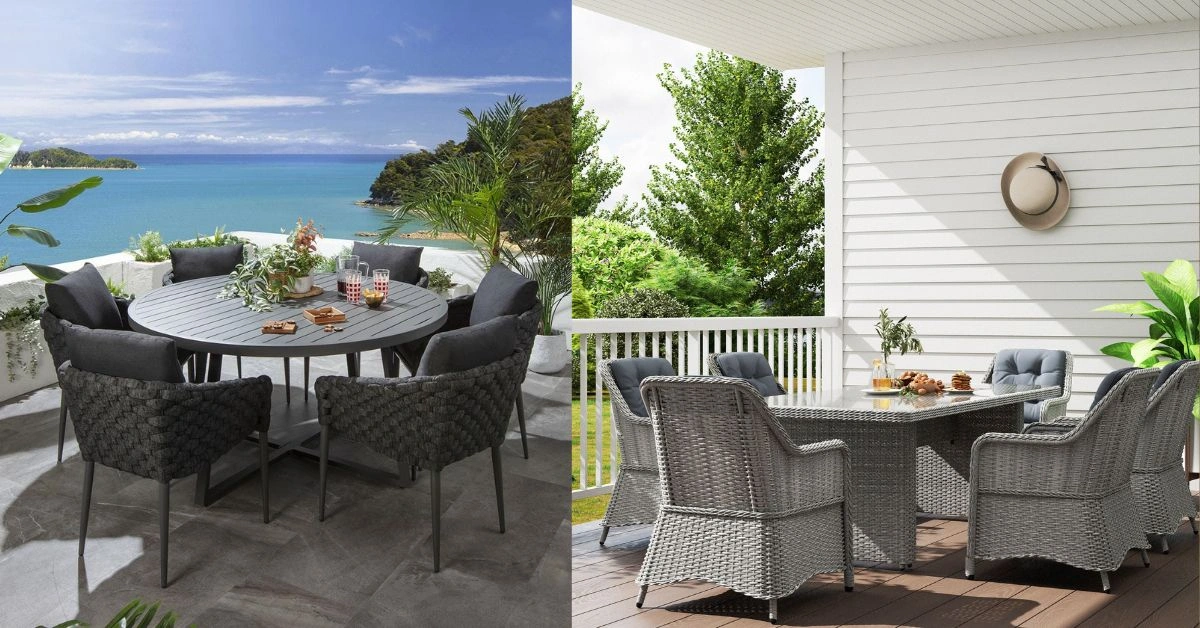
| Synthetic rattan over aluminium | Comfortable look, light, no rust | Cheap PE weave cracks under UV; check the core frame material |
With aluminium, the specification that matters is not visible in photographs. Look for a stated tube wall thickness of 1.5mm or more and welded rather than bolted joints at the chair frame. Bolted joints on thin tube are fine for a couple of summers, then they work loose and the chairs start to rock. With synthetic rattan, ask whether the weave is PE (polyethylene) rather than PVC, and whether the frame beneath it is aluminium or steel.
Outdoor seating sold in the UK is generally assessed against the BS EN 581 series for outdoor furniture, which covers strength, durability and stability. It is worth asking a retailer whether a set is tested to it, particularly for benches and stacking chairs where stability matters most.
Cushions, covers and where things go in November
Cushions decide whether a set gets used. Thin foam pads on a dining chair are tolerable for a meal; a lounge set needs real depth. The important question is drying: a cushion with a quick-dry foam core and a removable, machine-washable cover recovers from a shower in hours. A solid foam block in a fixed cover stays damp for days and eventually smells.
Be realistic about the carrying routine. If cushions have to be taken indoors every time rain threatens, they will end up left out. A lidded box on the patio changes the habit entirely, and our outdoor cushion storage guide covers ventilated options that do not trap moisture.
For the furniture itself, a cover needs to shed water and breathe. Fully waterproof covers with no vents trap condensation and can do more damage than leaving a set uncovered. Look for a fitted shape, air vents, a tie-down or drawcord, and drainage at the lowest point. Our garden furniture covers guide explains how to size one so it does not act as a sail.
Shade, and why it changes your layout
A six-seater table with a central parasol hole restricts you to a through-pole parasol, and the pole lands exactly where the serving dishes want to be. A cantilever parasol keeps the table clear but needs a heavy base and a swing arc that misses the fence and the washing line.
Base weight is the part most often skimped. A large cantilever needs substantially more ballast than a small centre-pole model, and a parasol that tips takes glassware with it. Our guides to cantilever parasols and choosing a parasol base weight set out the figures. Always close a parasol when you leave the garden, however calm it seems.
Before you buy: the checks worth making
- Delivery access. Measure your side gate and any turns. A 200cm ceramic tabletop cannot be angled through a 76cm gate.
- Weight of the tabletop. Ceramic and stone are excellent surfaces and need two people for every move. Check whether it arrives as one piece.
- Chair stacking. Stackable chairs transform winter storage in a small garden or shed.
- Replacement parts. Ask whether individual cushions, feet and glass or slats can be bought separately in two years’ time.
- Foot type. Plastic glides mark soft paving and hard feet scratch decking; felt or rubber pads are worth adding.
- Ground condition. A loaded six-seater on soft ground or a rocking slab is a genuine hazard, especially with a parasol fitted.
- Assembly. Find out how many bolts and how many people. Some six-seaters are a two-hour, two-person job.
Keeping a set going
Wash frames with warm soapy water and a soft brush at the start and end of the season, and rinse off salt if you are near the coast. Do not use a pressure washer on powder coating, synthetic weave or timber: it drives water into joints and lifts finishes. Touch up any chips in powder coating promptly, because bare aluminium is fine but exposed steel is not.
Check and tighten bolts once a season. Timber sets need a clean and, if you want to keep the honey colour, an oil in spring; left alone, teak silvers without losing strength. Store cushions dry, not merely out of the rain, and lift furniture feet off standing water over winter where you can.
Frequently Asked Questions
1. What size patio do I need for 6 seater garden furniture?
Allow about 3.5m x 3.5m for a round six-seater and roughly 4.5m x 3m for a rectangular set, measured as clear space with chairs pulled out. A corner or cube set can work in around 3m x 2.5m because the seating tucks in against boundaries.
2. Can 6 seater garden furniture be left outside all year?
Aluminium, teak and good synthetic rattan sets can stay out with a breathable, vented cover. Cushions should always come in or go into ventilated storage. Steel-framed sets and cheap thin-wall aluminium fare much better under cover or stored away over winter.
3. Is a round or rectangular six-seater better?
Round suits square patios and conversation, since nobody sits at the head. Rectangular fits long, narrow spaces, seats a seventh person at a push, and takes serving dishes down the centre more easily. Choose by patio shape first.
4. What is the most durable material for UK garden furniture?
Cast aluminium and teak last longest with least attention. Cast aluminium will not rust and is heavy enough to stay in place in wind; teak is exceptionally stable and can be sanded back after years outdoors. Both cost more upfront than steel or thin tubular sets.
5. How much should I spend on a six-seater set?
Prices are wide, but the meaningful jump is between sets built on thin bolted tube and those on thicker welded frames. Check the frame specification and parts availability rather than the headline price, because a set you can repair is cheaper over ten years than one you replace twice.
Final thoughts
Buy the footprint before you buy the style. Tape out the space, check the gate, choose a frame that suits how much maintenance you will genuinely do, and make sure the cushions can dry and the cover can breathe. A well-matched six-seater becomes the reason you use the garden; an oversized one becomes an obstacle you edge around.
If you are still weighing up shapes and materials, our modular outdoor furniture guide is a good next read for flexible layouts, and rattan garden chairs covers weave and cushion quality in more depth.